Home / Custom / Optical Components / Infrared Optics / Sapphire Lens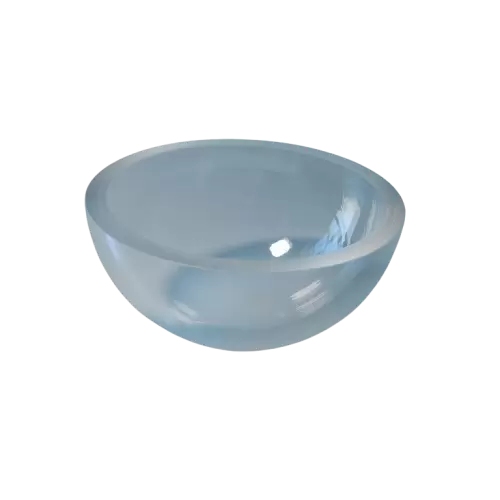
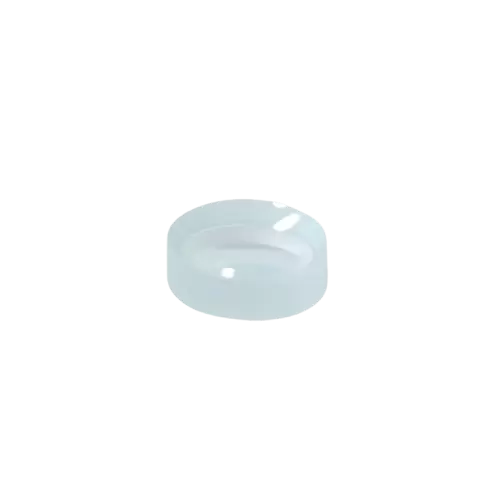
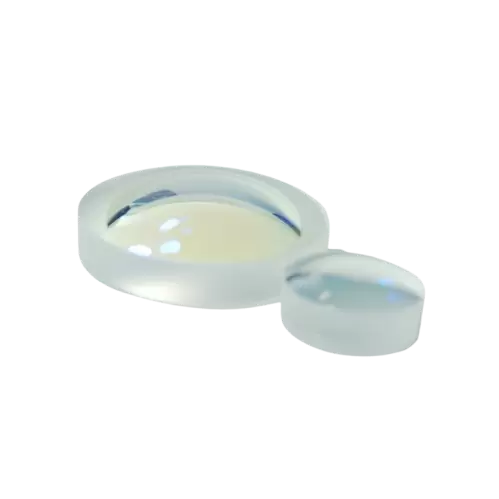
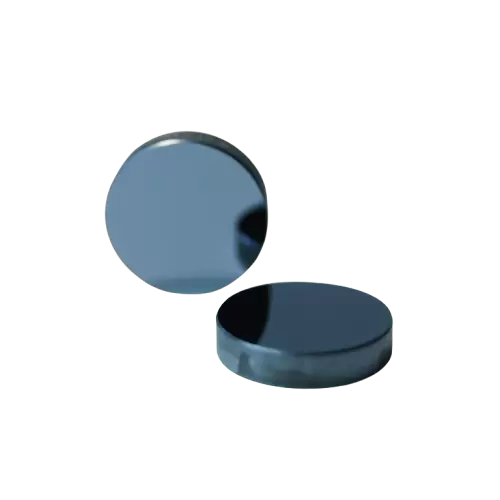
ECOPTIK provides a variety of sapphire optical components, such as sapphire lens, sapphire window, sapphire mirror, sapphire cylindrical lens, sapphire prism, sapphire light guide, sapphire dome etc.

It is one of the hardest materials after diamond, possessing extremely high compressive strength, scratch resistance, and the ability to withstand harsh environments such as high pressure and high-speed impacts.
Chemically extremely stable, resistant to strong acids, and does not absorb hydroxyl groups (OH groups) near 1.4μm, 2.2μm, and 2.7μm, making it suitable for chemical analysis instruments. Its melting point is as high as 2053°C, allowing it to withstand extremely high temperatures.
With a higher thermal conductivity than fused silica, it dissipates heat more quickly in high-power laser applications, effectively reducing focus drift caused by thermal effects.
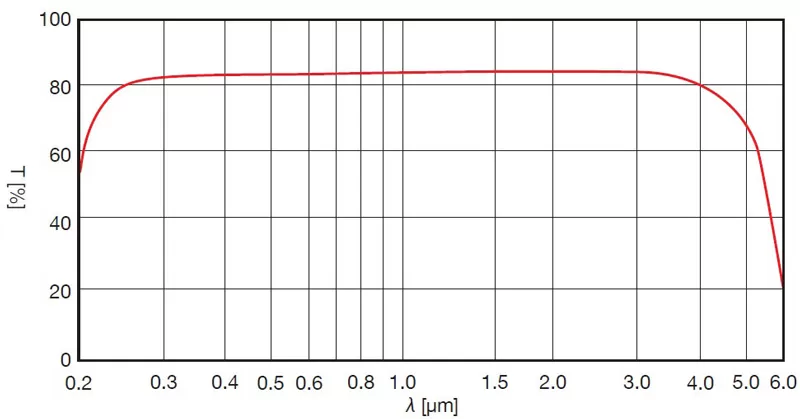
Its transmission band covers ultraviolet, visible, and mid-infrared light (approximately 0.15μm - 5.5μm). Its high refractive index (approximately 1.77) allows for thinner and lighter lenses with the same focal length.
Crystallographic | Syngony | Tetragon |
|---|---|---|
Symmetry Class | 3m | |
Lattice Constants | a = 4.758 Å c = 12.991 Å | |
Cleavability | (1011), (1120) imperfect | |
Optical | Refractive Index at ne | 1.7771 |
Refractive Index at nF' - nC' | 0.0107 | |
Thermal Coefficient of Refractive Index at 3.39 microns for ±60 °C | βo = (0.88 ... 1.28) x 10-5 βe = (0.99 ... 1.39) x 10-5 | |
Spectral Range, microns | 0.17 - 5.0 | |
Thermal | Thermal Linear Expansion, °C-1 for ±60 °C | |
⊥ to c-axis | (3.24 ... 5.66) x 10-6 | |
Thermal Conductivity, W/(m * °C) at 46 °C | ||
⊥ to c-axis | 25.2 | |
|| to c-axis | 23.1 | |
Specific Heat Capacity, J/(kg * °C) | 0.7610 x 10³ | |
Thermal Stability, °C | 162 ±8 | |
Melting Point, °C | 2030 | |
Chemical | Molecular Weight | 101.96 |
Solubility in water, gram/100 cm3 | 98 x 1010 | |
Wavelength, Microns | Refractive Index no | Refractive Index ne |
|---|---|---|
1.0 | 1.7545 | 1.7460 |
2.0 | 1.7374 | 1.7299 |
3.0 | 1.7015 | 1.6920 |
4.0 | 1.6748 | 1.6679 |
Wavelength, Microns | Internal Transmittance |
|---|---|
0.2 | 0.79 |
0.5 | 0.97 |
1.0 | 0.97 |
3.0 | 0.97 |
5.0 | 0.45 |
Commercial grade | Precision grade | High precision grade | |
|---|---|---|---|
Diameter | 1-300mm | ||
Diameter tolerance | ±0.1mm | ±0.05mm | ±0.01mm |
Thickness tolerance | +0/-0.1mm | ±0.05mm | ±0.01mm |
Parallelism | <3 arc min | <30 arc sec | <5 arc sec |
Surface quality: | 60/40 | 40/20 | 20/10 |
Surface accuracy | λ | λ/4 | λ/10 |





 en
en
 English
 繁体中文
繁体中文 Japanese
 Korean
 Russian
 German