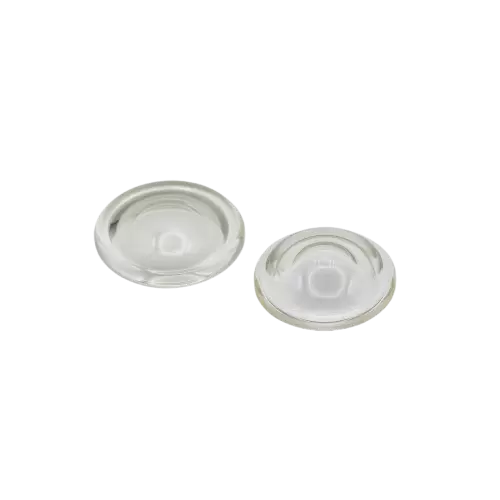
Home / Custom / Optical Components / Aspherical Lens / Precision Polishing Aspherical Lens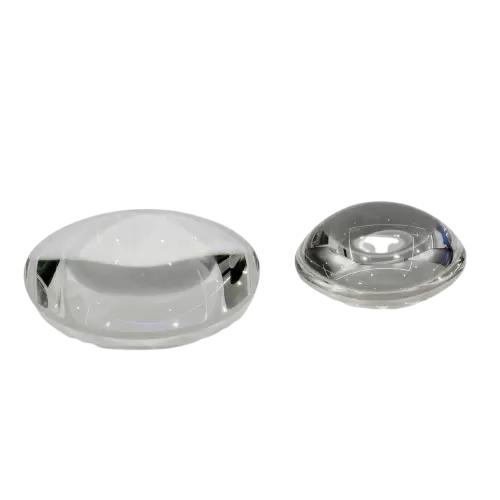
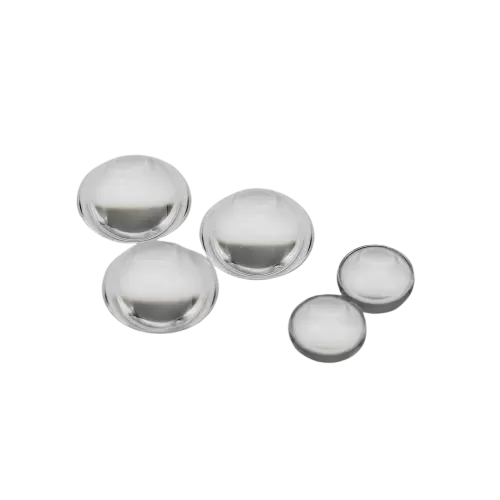
Traditional spherical lens will produce spherical aberration. Spherical lenses have an unsatisfactory property (called spherical aberration), which leads to stronger diffraction the farther the light rays are from the optical axis of the lens, and spherical aberration leads to decreased image sharpness. The shape of an aspheric lens is optimized and has excellent imaging characteristics. The main advantage is the ability to correct spherical aberrations.

Optical glass such as K9, fused silica, sapphire, MgF2, silicon (Si), ZnSe, ZnS, etc. These materials possess high transmittance, low absorption, low scattering, uniform refractive index, and specific dispersion characteristics.

Precisely hemispherical. The machining precision of the center and radius of curvature of the sphere is extremely high.

The surface is precision polished to an optical grade of 10-5 to ensure image quality and reduce scattering and aberrations.

An AR coating is typically applied to the concave surface to maximize the transmittance of specific wavelengths of light (e.g. visible light) and reduce reflection loss.
The following figure compares the focus points produced by parallel monochromatic light passing through a spherical lens, where the imaging points are blurred due to spherical aberration, and an aspherical lens, where the imaging points are very clear. Therefore, aspherical lens can be used to replace spherical lens group to correct orthodoxies. For example, for zoom lenses that generally use ten lenses, one or two aspherical lenses can be used to replace five or six spherical lenses, which can achieve the same or higher optical effect, reduce production costs, and realize lightweight and miniaturization of the system. In addition, optical systems that reduce the number of lenses also reduce mechanical tolerances, additional calibration steps, and anti-reflection coating film requirements, improving overall system utility and reducing overall system design costs.
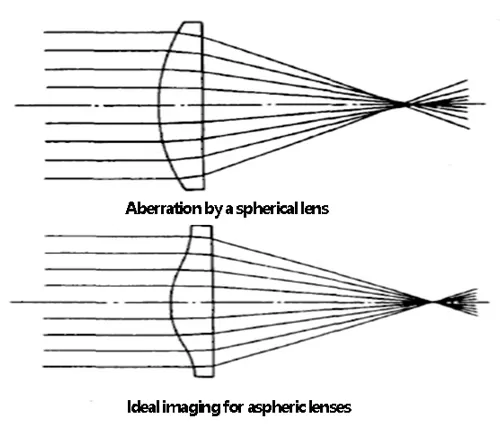
The use of aspheric elements in the optical system can improve the performance of the system and reduce the number of optical elements, thus reducing the quality, volume, and compact structure of the instrument. Therefore, aspheric optical elements are often used in optical systems with large field of view, large aperture, high aberration requirements, small structural requirements, or special requirements. Aspheric optical elements are increasingly becoming a kind of very important optical elements because of their excellent optical properties.





 en
en
 English