

 en
en
 English
 繁体中文
繁体中文 Japanese
 Korean
 Russian
 German
News
Deepen Optoelectronic Resources, Lead Technological Breakthroughs

Deepen Optoelectronic Resources, Lead Technological Breakthroughs
Brewster windows are critical uncoated optical components in high-power laser systems, enabling zero‑reflection-loss transmission for p‑polarized light at Brewster's angle while suppressing s-polarized light. This paper reviews the working principle, material selection, angle tolerance control, surface quality specifications, and typical applications of Brewster windows for high‑power lasers, providing a complete design framework for high-efficiency, high‑damage‑threshold laser cavities.
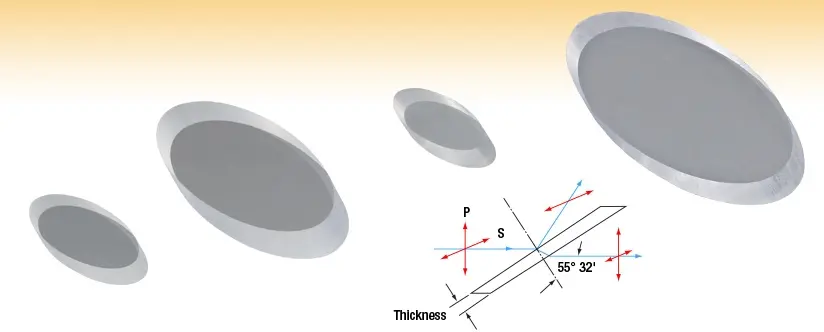
In high-power laser resonators, minimizing insertion loss and ensuring polarization purity are essential. A Brewster window is a tilted plane parallel plate mounted at Brewster's angle to the optical axis. It eliminates reflective loss for p-polarized light without coatings, suppresses s-polarized light via selective reflection, and improves beam polarization purity and output stability.
Brewster windows operate based on Brewster’s angle and Fresnel equations.
● When light is incident at Brewster's angle θ_B, the reflected beam is purely s-polarized, and p-polarized light has zero reflectance and fully transmits.
● The reflected and refracted beams are mutually perpendicular.
● Brewster's angle formula:θ_B = arctan(n)where n is the refractive index of the window material.
● For fused silica (n≈1.46@633 nm), θ_B≈55.57°.
● For ZnSe (n≈2.4@10.6 μm), θ_B≈67.4°.
In a laser cavity, multiple round trips strongly attenuate s-polarized light, resulting in high-purity linearly polarized output.
Key requirements: high laser-induced damage threshold (LIDT), low absorption, wide transparency, good thermal conductivity, and stable mechanical properties.
● Transparency: 185 nm–2.1 μm
● n≈1.46; θ_B≈55.57°
● High LIDT, low fluorescence, low thermal expansion
● Preferred for solid-state, fiber, and ultrafast lasers
● Transparency: 350 nm–2.0 μm
● n≈1.51; θ_B≈56.5°
● Good polishability and low cost
● Used for low-to-medium power systems
● Transparency: 0.5 μm–22 μm
● n≈2.4@10.6 μm; θ_B≈67.4°
● High IR transmission
● Standard for CO₂ high-power lasers
● High hardness, thermal conductivity, and LIDT
● Used in extreme high-power and harsh environments
Angle error directly degrades p-polarization transmittance and increases loss.
● Angle tolerance: ≤±0.1° for high-power systems
● Parallelism: ≤5–10 arcseconds to avoid beam deflection
● Tilt error >0.5° causes noticeable reflection loss and reduced polarization purity
High-power laser demands strict surface quality to avoid scattering, absorption, and damage.
● Laser grade: 10–5 or 20–10 scratch-dig
● Minimizes particle-induced damage
● ≤ λ/10 @ 632.8 nm over clear aperture
● Preserves wavefront quality
● 90% of the minor axis
● Ensures full beam passage
● Fine ground edges for mechanical stability
● Uncoated for highest LIDT; optional hydrophobic film for contamination resistance
Used in He–Ne, CO₂, solid-state, and fiber lasers to generate linearly polarized output with low loss.
Reduces reflective loss and thermal lensing in high-power transmission systems.
Improves polarization extinction ratio in scientific and industrial setups.
Fused silica Brewster windows support high-peak-power, ultrafast systems.
● Principle: θ_B = arctan(n); p-polarization transmits with zero reflection loss.
● Materials: fused silica (UV–NIR), ZnSe (IR), BK7 (general purpose).
● Tolerance: angle ±0.1°, parallelism ≤10 arcsec.
● Surface: 10–5 scratch-dig, flatness ≤λ/10.
● Applications: laser cavities, beam delivery, polarization control.
Brewster windows are indispensable in high-power laser systems. Proper design—material choice, tight angle tolerance, and laser-grade surface specs—ensures low loss, high damage threshold, and stable polarization output. They will remain key in advanced high-power laser development.
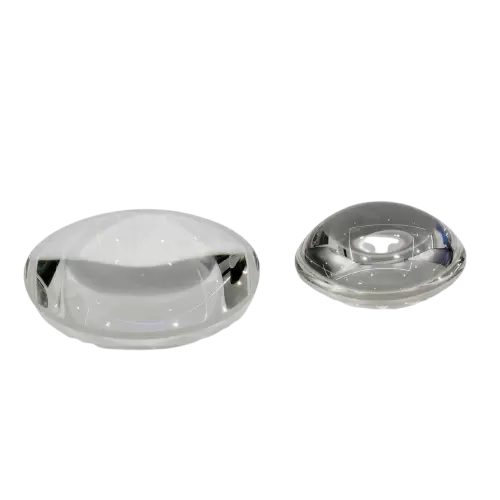
In modern precision optics manufacturing, the performance of a spherical lens is no longer determined solely by its material or nominal curvature, but by the surface precision achieved during the polishing stage.
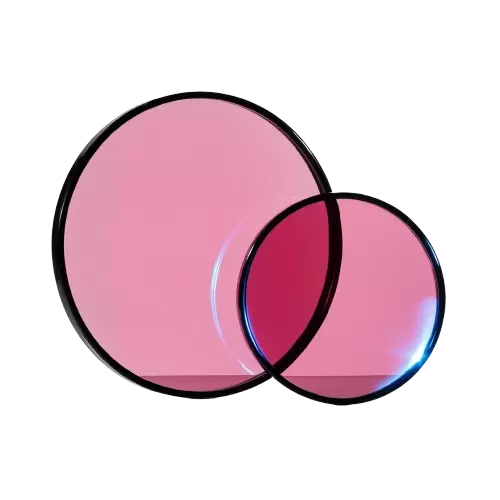
In precision optical systems, selecting the correct wavelength is often more important than simply collecting more light. Conventional optical filters may struggle with limited spectral selectivity, unstable center wavelength control, insufficient out-of-band blocking, and unwanted stray light interference.
Calcium fluoride (CaF2) crystals play an irreplaceable role in the high-end optical field due to their unique optical properties. Its core advantages lie in its deep ultraviolet transmission capability and optical isotropy (without birefringence), making it the preferred material in multiple key fields.