

 en
en
 English
 繁体中文
繁体中文 Japanese
 Korean
 Russian
 German
News
Deepen Optoelectronic Resources, Lead Technological Breakthroughs


Deepen Optoelectronic Resources, Lead Technological Breakthroughs
In advanced optical engineering, the search for optical prism construction solutions and high-precision Beam Splitter Penta Prism components is no longer centered on whether a prism can deflect light. That capability is assumed.
Instead, system designers, optical engineers, and procurement teams are evaluating whether a penta prism can maintain absolute angular stability, wavefront integrity, and long-term optical axis consistency under real operating conditions.
In high-end imaging systems such as DSLR viewfinder assemblies, metrology instruments, aerospace alignment modules, and precision inspection devices, the true performance indicators are:
Stability of the 90° beam deviation under mechanical tolerance variation
Preservation of image orientation without rotational drift
Minimal wavefront distortion after multi-surface internal reflection
High transmission efficiency with controlled scattering loss
Long-term optical axis stability under vibration and temperature cycling
The ECOPTIK Optical Penta Prism system is engineered specifically to address these constraints through ultra-precise five-surface optical architecture design, nanometer-level surface control, and advanced coating integration.
In modern optical engineering, optical prism construction is defined by how a prism manages:
Multi-surface internal reflection paths
Angular deviation stability under tolerance accumulation
Wavefront preservation across reflective interfaces
Coating behavior under multi-angle incidence
Unlike simple reflective optics, a penta prism introduces a fixed geometric optical constraint system, where performance is determined by the interaction of five precision surfaces.
A penta prism operates through two internal reflective surfaces that define a stable 90° deviation path. However, real performance depends on:
Surface angular alignment precision
Internal reflection path symmetry
Coating uniformity across reflective planes
In optical prism construction:
A few arc seconds of angular deviation can translate into measurable image displacement
Surface flatness deviations directly affect wavefront phase stability
Coating thickness variation introduces phase shift imbalance
This makes penta prism design a system-level precision engineering problem, not a standalone component design.
The Beam Splitter Penta Prism is used in optical systems where both beam deviation and image stability are required simultaneously.
Unlike conventional reflective prisms, its defining characteristic is:
The ability to maintain a fixed 90° deviation angle regardless of minor mechanical or alignment variations, while preserving image orientation stability.
Fixed angular deviation stability (± arc-second level control)
Image orientation invariance under multi-reflection paths
High repeatability in optical axis positioning
Low sensitivity to installation tolerance variations
In high-end optical assemblies:
Viewfinder optical paths require absolute alignment consistency
Measurement systems require repeatable optical referencing
Imaging modules require distortion-free beam routing
This places strict demands on prism geometry and optical surface precision.
ECOPTIK, with 15 years of optical component manufacturing expertise, develops precision optics including prisms, lenses, mirrors, filters, windows, and micro-optical components.
The company utilizes premium optical materials such as:
Schott optical glass
Corning substrates
CDGM optical materials
Sapphire
CaF₂, MgF₂
Fused silica
Silicon (Si)
Zinc selenide (ZnSe), Zinc sulfide (ZnS)
And operates advanced metrology systems:
ZYGO laser interferometers for wavefront analysis
ZEISS CMM Spectrum for dimensional verification
Agilent Cary 7000 UMS for optical performance characterization
This ensures every penta prism is evaluated not only geometrically, but also in terms of optical phase integrity and multi-surface reflection consistency.
In high-end optical systems, performance degradation is rarely caused by failure of reflection. Instead, it arises from subtle multi-surface optical inconsistencies.
Even minimal angular deviations in any of the five surfaces can cause:
Optical axis displacement
Image position drift in viewfinder systems
Calibration error in measurement instruments
If reflective surfaces are not perfectly aligned:
Beam path symmetry is disrupted
Phase delay differences occur between reflections
Image consistency is reduced
Surface flatness errors introduce phase irregularities
Micro-roughness increases scattering and reduces contrast
Subsurface damage affects long-term stability
Reflectivity imbalance between surfaces
Wavelength-dependent phase shift errors
Reduced transmission efficiency in multi-pass systems
The core innovation of ECOPTIK optical penta prisms is:
Nanometer-level angular consistency control combined with full internal reflection path optimization
Each prism is manufactured with strict control over:
Internal reflective surface alignment symmetry
External surface angular accuracy
Cross-surface deviation minimization
Standard angular deviation control: <10 arc seconds
High-precision grade: ≤2 arc seconds
This ensures:
Stable 90° beam deviation under mechanical stress
Minimal long-path optical drift
Repeatable alignment behavior in assembly systems
λ/2 to λ/10 @ 632.8nm
This enables:
Wavefront preservation during internal reflections
Reduced phase distortion in imaging systems
Higher optical coherence stability
A key factor in Beam Splitter Penta Prism performance is coating design.
ECOPTIK provides:
Aluminum coatings (broadband, cost-efficient)
Silver coatings (high reflectivity in visible range)
Dielectric multilayer coatings (high precision spectral control)
Transmitting surfaces use AR coatings designed to:
Minimize Fresnel reflection losses
Improve transmission efficiency across wavelength bands
Reduce ghost image formation
Higher optical throughput stability
Reduced multi-reflection energy loss
Improved contrast in imaging systems
One of the most critical issues in high-end optical systems is internal ghosting and stray light formation.
ECOPTIK addresses this through:
Ultra-smooth polishing of reflective surfaces
Controlled micro-roughness suppression
Multi-surface optical path alignment optimization
Reduced internal stray reflection loops
Improved image contrast stability
Cleaner optical signal transmission
In real-world systems, optical performance must remain stable under:
Mechanical vibration
Thermal expansion cycles
Long-term structural stress
ECOPTIK ensures stability through:
Precision bonding and mounting compatibility design
Matched thermal expansion material selection
High structural rigidity prism geometry
Stable optical axis alignment under environmental stress
Reduced calibration drift over time
Consistent imaging position in long-term operation
ECOPTIK Beam Splitter Penta Prism systems are widely used in:
DSLR and professional camera viewfinder systems
Precision measurement instruments
Optical alignment calibration systems
Industrial imaging inspection equipment
Scientific optical research platforms
Aerospace optical guidance modules
In these environments, system performance depends on:
Optical axis repeatability
Angular deviation stability
Multi-reflection phase coherence
ECOPTIK supports a wide range of optical construction parameters:
Material: N-BK7 / H-K9L
Diameter tolerance: ±0.1mm
Surface quality: 60/40 / 40/20 / 20/10
Clear aperture: >85%
Bevel: <0.25mm × 45°
Custom dimensions based on drawings
This allows direct integration into:
Optical assembly modules
Imaging system housings
Precision metrology platforms
Selecting a Beam Splitter Penta Prism is not a component choice—it is a system-level optical architecture decision.
Key evaluation factors include:
Angular deviation stability over time
Multi-surface phase consistency
Optical transmission efficiency
Environmental robustness
Integration tolerance flexibility
In modern precision optics, optical prism construction is fundamentally about controlling:
Wavefront integrity
Angular stability
Multi-surface reflection consistency
Long-term optical axis reliability
The ECOPTIK Beam Splitter Penta Prism system achieves this through:
Nanometer-level angle consistency control
Five-surface ultra-precision polishing architecture
Advanced multilayer reflective and AR coatings
High-performance optical materials from Schott, Corning, CaF₂, and fused silica
Interferometric and metrology-based quality validation
Together, these capabilities ensure stable optical performance in demanding imaging, measurement, and alignment systems where even microscopic deviations directly impact system accuracy.
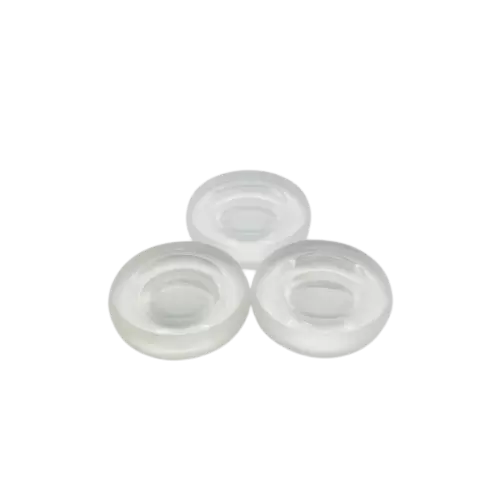
A positive lens is often the natural choice when an optical system needs to focus or converge light, but it cannot solve every beam-control problem. Laser and imaging systems may instead require a controlled increase in beam divergence, a larger beam diameter, or an adjustment that effectively increases the focal length of an existing optical arrangement.
High-performance optical systems are no longer evaluated solely by focal length or magnification. As industrial inspection, machine vision, microscopy, spectroscopy, and scientific imaging continue to demand higher spatial resolution and greater measurement accuracy, optical designers are placing increasing emphasis on chromatic correction, wavefront quality, imaging consistency, and long-term optical stability.

In precision optical systems, beam steering is not simply about “redirecting light.” It is about controlling optical path geometry, preserving wavefront integrity, minimizing phase distortion, and maintaining long-term alignment stability under varying incidence angles and environmental conditions.