

 en
en
 English
 繁体中文
繁体中文 Japanese
 Korean
 Russian
 German
News
Deepen Optoelectronic Resources, Lead Technological Breakthroughs


Deepen Optoelectronic Resources, Lead Technological Breakthroughs
In modern precision optics manufacturing, the performance of a spherical lens is no longer determined solely by its material or nominal curvature, but by the surface precision achieved during the polishing stage. The Spherical lens polishing machine has therefore become the core enabling equipment in high-end optical fabrication, where nanometer-level surface control directly defines imaging performance, wavefront integrity, and system-level aberration behavior.
In industrial optical engineering, procurement teams evaluating spherical lens production systems are not simply comparing equipment specifications. They are assessing whether the polishing process can consistently control surface form error (PV and RMS), suppress mid-spatial frequency errors, and eliminate common defects such as edge roll-off, orange peel texture, and localized over-polishing. These factors ultimately determine whether a lens can meet the requirements of high-end imaging, laser focusing, or precision sensing systems.
At the same time, when engineers analyze spherical lens uses, the focus is not only on application categories but on functional optical roles—how spherical lenses control light convergence, correct aberrations, and define imaging pathways in systems such as camera modules, microscopes, laser delivery systems, and optical sensors.
ECOPTIK, with 15 years of experience in precision optical manufacturing, specializes in spherical lenses, aspherical optics, prisms, and micro-optical components. Using advanced CNC polishing systems, MRF (Magnetorheological Finishing), IBF (Ion Beam Figuring), and high-end metrology platforms such as ZYGO laser interferometers and ZEISS CMM systems, ECOPTIK delivers high-precision optical components with surface accuracy reaching λ/40 RMS (~15 nm), enabling consistent performance in demanding optical applications.
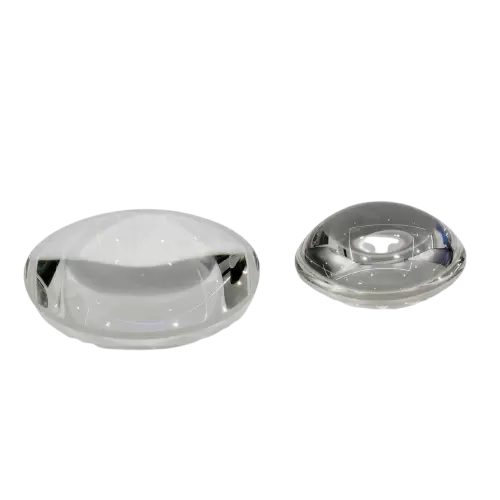
A Spherical lens polishing machine is not a simple surface finishing tool; it is a precision deterministic manufacturing system designed to control material removal at nanometer-scale resolution while maintaining strict geometric curvature consistency across the entire optical surface.
Unlike traditional grinding or molding processes, precision polishing systems operate through controlled interaction between:
Mechanical pressure distribution systems that regulate contact force between polishing tool and optical surface
Computer-controlled motion trajectories that define deterministic material removal paths across spherical geometries
Chemical-mechanical interaction between polishing slurry and optical substrate material
The objective is not merely to smooth the surface, but to converge the optical surface toward a mathematically defined ideal sphere with extremely low deviation in both global curvature and local surface texture.
One of the most critical factors in spherical lens polishing is pressure uniformity across the optical surface. Uneven pressure distribution leads to localized deformation and surface figure deviation.
Advanced polishing systems incorporate:
Multi-zone pressure control architectures that independently regulate force distribution across different radial zones of the lens
Adaptive compliance mechanisms that adjust contact pressure in real time based on surface feedback
Dynamic load balancing systems that compensate for curvature variation during continuous polishing cycles
These systems ensure that material removal remains consistent across the entire aperture, preventing distortion of the spherical geometry.
Edge deformation is one of the most common failure modes in spherical lens polishing. It occurs when pressure and tool geometry interact non-uniformly at the boundary region of the lens.
Engineering control strategies include:
Tool path deceleration algorithms near edge regions to reduce excessive material removal
Compensation models that pre-adjust polishing trajectories based on predicted edge behavior
Adaptive polishing head geometries that maintain uniform contact pressure even at curved boundaries
These controls are essential for maintaining full-aperture optical consistency.
Modern Spherical lens polishing machine systems rely heavily on CNC-driven deterministic polishing paths that define exact material removal patterns.
These systems use:
Spiral and raster motion algorithms that distribute polishing energy evenly across the surface
Real-time curvature compensation models that adjust tool movement based on local surface geometry
Feedback loops that integrate metrology data into polishing trajectory updates
This deterministic approach ensures repeatable convergence toward target surface shape rather than random surface smoothing.
In high-end optical manufacturing, surface quality is evaluated using both PV (Peak-to-Valley) and RMS (Root Mean Square) error metrics.
Engineering control focuses on:
Reducing PV errors to eliminate extreme surface deviations that affect wavefront distortion
Minimizing RMS error to improve overall wavefront uniformity and imaging stability
Controlling mid-spatial frequency errors that directly influence stray light and image contrast
High-precision polishing systems can achieve surface accuracy at λ/40 RMS (~15 nm), which is critical for advanced imaging systems.
Polishing slurry acts as both a chemical and mechanical mediator between the tool and optical surface.
Its functions include:
Facilitating controlled micro-scale material removal through abrasive particle interaction
Reducing mechanical stress concentration to prevent subsurface damage formation
Stabilizing thermal and chemical interaction during continuous polishing cycles
The composition and particle size distribution of slurry directly influence surface roughness and optical clarity.
One of the key challenges in spherical lens manufacturing is preventing subsurface damage that cannot be removed by surface polishing alone.
Advanced techniques such as MRF and IBF help:
Remove material with atomic-level precision control
Eliminate micro-cracks generated during earlier grinding stages
Maintain high laser damage threshold for optical components used in high-energy systems
This is particularly important in laser optics and high-power imaging systems.
Surface roughness determines how much light is scattered at the optical interface. In precision spherical lenses, maintaining ultra-low roughness is essential for high transmission efficiency.
Engineering control includes:
Nano-scale polishing media selection for controlled surface smoothing
Multi-stage polishing processes that progressively reduce surface irregularities
Real-time surface metrology feedback using interferometric measurement systems
Full-aperture optical performance requires consistent edge-to-center surface behavior.
Control strategies include:
Edge-specific dwell time adjustment in polishing trajectories
Compensation models for material removal rate variation near curvature transitions
Mechanical stabilization of lens edges during polishing to prevent deformation
In imaging systems, spherical lenses are used to converge and focus light onto sensors. Their curvature precision directly affects:
Image sharpness across the field of view
Spherical aberration control in multi-element lens assemblies
Light distribution uniformity across imaging sensors
Higher precision polishing results in improved imaging consistency, especially in low-light or high-resolution environments.
In microscopy systems, spherical lenses are used for controlled magnification and beam shaping.
Key performance requirements include:
High numerical aperture stability for fine detail resolution
Minimal wavefront distortion to preserve specimen accuracy
Precise curvature matching in multi-lens optical stacks
Even small surface deviations can significantly impact imaging fidelity at microscopic scales.
Spherical lenses are widely used in laser optics for beam focusing and shaping.
Engineering requirements include:
High laser damage threshold surface quality to withstand high-energy beams
Minimal scattering to maintain beam coherence and focus precision
Thermal stability under continuous laser exposure conditions
In optical sensing applications, spherical lenses define how light is collected and directed into detectors.
Performance depends on:
Signal-to-noise ratio control through optical clarity optimization
Precise focusing geometry for accurate measurement resolution
Stability under environmental variation such as temperature and vibration
These are typically used in general imaging systems where moderate tolerance is acceptable. They provide functional performance but may exhibit higher aberration levels in demanding applications.
These lenses feature controlled RMS error, improved curvature consistency, and reduced surface roughness, making them suitable for advanced imaging, laser systems, and scientific instruments.
These represent the highest manufacturing tier, used in aerospace optics, high-end microscopy, and laser systems requiring extreme wavefront control and minimal optical distortion.
ECOPTIK specializes in precision optical fabrication with a focus on high-performance spherical and aspherical lens systems. The company integrates:
CNC polishing systems for deterministic surface shaping
MRF and IBF technologies for ultra-precision surface correction
Advanced optical metrology using ZYGO interferometers for wavefront validation
ZEISS CMM systems for geometric accuracy verification
High-performance materials including Schott, Corning, CaF2, MgF2, and fused silica
With a manufacturing capability reaching λ/40 RMS surface accuracy, ECOPTIK supports applications requiring extreme optical precision and long-term stability in industrial and scientific environments.
The performance of a Spherical lens polishing machine is fundamentally defined by its ability to control pressure distribution, deterministic polishing trajectories, and material interaction at nanometer-scale resolution. These engineering controls directly determine whether a spherical lens can achieve high-precision curvature consistency and optical surface quality.
Similarly, understanding spherical lens uses requires a system-level perspective, where spherical lenses are not isolated components but critical optical elements that define imaging pathways, beam behavior, and measurement accuracy in complex optical systems.
ECOPTIK’s precision manufacturing capability demonstrates how advanced polishing technologies and metrology systems converge to produce high-performance optical components capable of meeting the stringent demands of modern imaging, laser, and sensing applications.

Selecting the right bandpass filter is not simply a matter of choosing a component that allows certain signals to pass. In optical systems, wireless communication equipment, and precision measurement devices, filter performance directly affects signal quality, detection accuracy, and system reliability.

In modern precision optics engineering, the search for Right angle prism types is no longer about understanding geometric variations of a prism structure. Instead, optical engineers, system integrators, and procurement teams are evaluating how different prism configurations affect beam stability, angular precision, and long-term optical path integrity in high-performance systems.

Learn what a super hemisphere dome is in precision optics, how it protects sensitive systems, and why custom optical dome manufacturing matters.