

 en
en
 English
 繁体中文
繁体中文 Japanese
 Korean
 Russian
 German
News
Deepen Optoelectronic Resources, Lead Technological Breakthroughs


Deepen Optoelectronic Resources, Lead Technological Breakthroughs
In precision optical systems, beam steering is not simply about “redirecting light.” It is about controlling optical path geometry, preserving wavefront integrity, minimizing phase distortion, and maintaining long-term alignment stability under varying incidence angles and environmental conditions.
For engineers working in laser metrology, machine vision systems, interferometric measurement, scientific instrumentation, and high-end optical inspection platforms, the question behind What is a right angle prism used for is not conceptual—it is architectural. It defines how optical paths are constructed inside high-precision systems where every micron of beam deviation matters.
Similarly, the comparison of Right angle prism vs mirror is not a theoretical debate. It is a system-level engineering decision that directly impacts optical loss, phase stability, alignment tolerance, and long-term calibration reliability.
This article provides a detailed optical engineering breakdown of right angle prism systems, focusing on beam steering mechanics, total internal reflection behavior, coating design influence, and system integration performance in high-precision optical environments.
It also introduces ECOPTIK’s proprietary engineering framework: the Total Internal Reflection Path Stabilization & Phase Consistency Optimization System, designed to ensure stable beam deviation accuracy and minimal wavefront distortion in complex optical architectures.

Modern optical systems rely heavily on controlled beam steering rather than straight-line propagation. In compact optical architectures, space constraints and system integration requirements demand precise optical redirection without degrading signal quality.
Right angle prisms are designed to solve three core engineering challenges:
Precise 90° beam deviation without mechanical complexity
Stable 180° retroreflection geometry in optical feedback systems
Image orientation control in imaging and measurement systems
Unlike flat mirrors, which rely on surface reflection physics, right angle prisms use internal geometry to control light paths in a more structurally stable way.
A right angle prism operates primarily through total internal reflection (TIR) when light enters the prism at appropriate angles.
When light enters the prism:
It propagates through high-refractive-index optical glass
It reaches an internal boundary at an angle exceeding the critical angle
It undergoes total internal reflection without energy loss from metallic absorption
This mechanism allows:
Near-lossless beam redirection
High phase stability compared to reflective coatings
Improved long-term optical reliability
In a standard configuration:
Incident beam enters one leg of the prism
It reflects internally at the hypotenuse surface
It exits perpendicular to the original direction (90° deviation)
This geometry is widely used in:
Laser path folding systems
Compact optical instruments
Machine vision optical routing
Because beam deviation is defined by geometry rather than surface reflectivity:
Angular stability is highly repeatable
Alignment sensitivity is reduced
Long-term drift is minimized
This is a key advantage in precision optical systems.
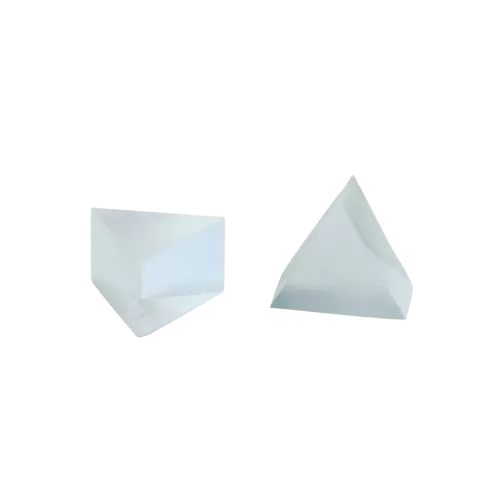
ECOPTIK manufactures precision optical components using 15 years of optical fabrication expertise.
The Right Angle Prism system is built on:
Optical-grade K9 glass
Fused silica substrates for high thermal stability
Ultra-precision polishing (surface flatness up to λ/10 level)
Advanced coating systems (Al + multi-layer protective anti-reflection coatings)
High internal reflectivity approaching ideal TIR efficiency
Minimal wavefront distortion across optical surfaces
Stable angular deviation under mechanical and thermal stress
A core innovation in ECOPTIK’s prism engineering is the Total Internal Reflection Path Stabilization & Phase Consistency Optimization System.
This system addresses one of the most critical challenges in precision optics: maintaining phase integrity and beam consistency under multi-angle and long-path optical propagation conditions.
The system ensures:
Stable internal reflection angles under variable incidence conditions
Reduced beam jitter caused by structural micro-deformation
Improved long-path alignment stability in complex optical assemblies
Engineering impact:
Higher beam steering accuracy in multi-element systems
Reduced calibration frequency in industrial setups
Improved repeatability in measurement systems
In precision optical systems such as interferometers, phase stability is critical.
The system minimizes:
Phase shift caused by surface imperfections
Wavefront distortion from internal reflection boundaries
Cumulative phase errors in multi-prism systems
Engineering impact:
Improved interferometric measurement accuracy
Higher coherence preservation in laser systems
Reduced signal noise in optical detection systems
Unlike metallic mirrors that introduce absorption losses, TIR-based prisms ensure:
Near-zero reflection loss under optimal conditions
Stable energy transmission efficiency
Reduced signal degradation over long optical paths
Understanding What is a right angle prism used for requires mapping its function into real optical system architectures.
In laser ranging and alignment systems:
Prism enables stable beam folding
Reduces system footprint without optical degradation
Maintains beam coherence over extended paths
In interferometric systems:
Phase stability is critical for measurement accuracy
Right angle prisms reduce phase noise accumulation
Improve fringe stability in interference patterns
In industrial imaging systems:
Enables compact optical path routing
Maintains consistent image orientation
Reduces optical distortion in multi-lens systems
In research applications:
Used in beam splitting and recombination setups
Supports multi-path optical experiments
Provides stable reference beam alignment
In high-end inspection systems:
Ensures stable optical alignment under vibration
Supports high-resolution measurement systems
Improves long-term calibration stability
The comparison between Right angle prism vs mirror is fundamentally a comparison between two optical physics principles: total internal reflection vs surface reflection.
Relies on metallic or dielectric coating reflection
Introduces absorption losses (typically 1–10% depending on coating quality)
Degrades over time due to coating aging
Uses total internal reflection
Near-zero absorption loss under correct conditions
Long-term stability without coating degradation (internal surfaces)
Engineering outcome:
Prisms provide superior energy efficiency in long optical paths.
Surface coating introduces phase shift variability
Sensitive to coating uniformity and degradation
Phase behavior governed by bulk material properties
More stable wavefront propagation
Engineering outcome:
Prisms are preferred in interferometric and metrology systems.
Highly sensitive to angular misalignment
Requires frequent recalibration in precision systems
Geometric beam steering reduces alignment dependency
More mechanically stable over time
Requires precise mounting and angular adjustment systems
Additional mechanical support needed
Integrated beam steering geometry
Simplifies optical system design architecture
ECOPTIK utilizes high-performance optical materials:
Schott optical glass
CDGM precision glass
Corning optical substrates
Fused silica for thermal stability
Sapphire for high-durability applications
CaF₂ / MgF₂ for specialized spectral systems
ZYGO laser interferometric surface testing
ZEISS CMM precision geometry inspection
Agilent Cary 7000 UMS spectral analysis
These systems ensure:
Sub-wavelength surface accuracy
High angular precision consistency
Batch-to-batch optical uniformity
Advanced coating systems include:
Aluminum reflective coatings (Al)
Multi-layer dielectric enhancement layers
Anti-reflection protective coatings
Coating function:
Enhances reflectivity where required
Reduces surface scattering
Improves environmental durability
Stable beam folding
Long-distance signal integrity preservation
Interferometric phase stability
High-precision measurement systems
Compact optical routing
Stable imaging geometry
Multi-beam experimental setups
Precision optical path control
Alignment-free beam steering
Robust long-term operation
When evaluating optical components in the context of What is a right angle prism used for or choosing between Right angle prism vs mirror, engineers should evaluate:
Loss tolerance in system design
Energy preservation needs
Interferometric precision level
Coherence preservation requirements
Vibration resistance
Long-term alignment stability
Integration simplicity
Calibration frequency
Temperature variation
Humidity and contamination resistance
Right angle prisms are not simple reflective components—they are precision optical path control elements that define beam geometry, phase stability, and system-level optical integrity in advanced optical systems.
Understanding What is a right angle prism used for requires viewing it as a structural element of optical system architecture rather than a standalone component. Likewise, the comparison of Right angle prism vs mirror is fundamentally a trade-off between surface reflection physics and internal total reflection geometry.
Through high-precision polishing, advanced coating technologies, and the Total Internal Reflection Path Stabilization & Phase Consistency Optimization System, ECOPTIK enables highly stable optical path control solutions for demanding industrial, scientific, and imaging applications.
In precision optics, mirrors redirect light—but prisms define the structure of the optical system itself.

In many optical systems, controlling the direction of light is not simply a matter of reflecting a beam at a desired angle. For precision instruments, laser measurement equipment, and imaging systems, the optical component must maintain a stable beam path over long periods while minimizing alignment errors.
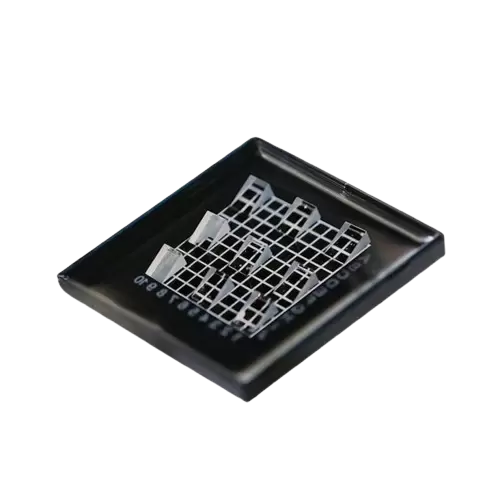
Standard optical prisms are not always practical when an optical path has to fit inside a few millimeters. In endoscopes, laser modules, fiber-coupling assemblies, and compact industrial instruments, a conventional prism can consume too much space, introduce unwanted optical path length, or simply lack the angular precision required by the system.
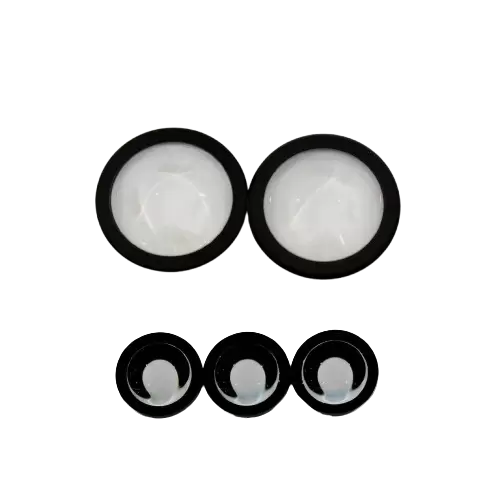
In precision optical systems, a lens that looks clear to the naked eye may still compromise the performance of the finished equipment. Insufficient transmission reduces the light reaching a sensor, chromatic aberration introduces color fringes around image details, and surface defects can create scattering or unwanted reflections.