

 en
en
 English
 繁体中文
繁体中文 Japanese
 Korean
 Russian
 German
News
Deepen Optoelectronic Resources, Lead Technological Breakthroughs


Deepen Optoelectronic Resources, Lead Technological Breakthroughs
Standard hemispherical lenses are useful in many optical assemblies, but they are not always suitable when an optical system requires a specific geometry, material, wavelength response, or integration envelope. Fixed commercial dimensions can create compromises in radius of curvature, center thickness, aperture, or working distance. In imaging and laser systems, even a small geometric mismatch can affect the optical path, focal behavior, aberration correction, and final image quality.
This is where custom-designed hemispherical lenses become valuable. A Custom Hyper Hemisphere Lens is manufactured around the requirements of the optical system rather than around a standard catalog size. For engineers and procurement teams, the key question is therefore not simply how much the lens costs, but whether its geometry, material, surface quality, coating, and dimensional tolerances are appropriate for the intended optical design.
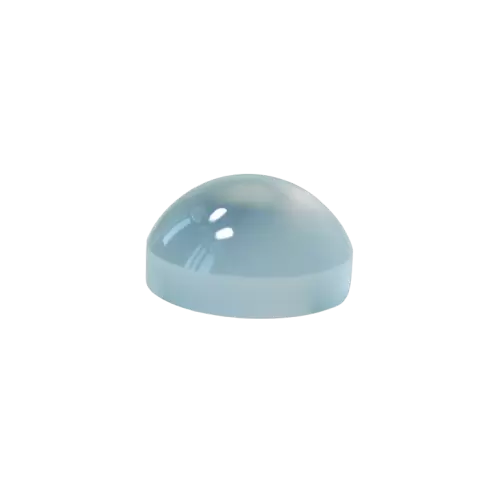
A conventional hemispherical lens has a geometry based on a sphere in which the center thickness is approximately related to the radius of curvature. A hyper hemisphere lens uses a deeper spherical geometry, with center thickness greater than the radius of curvature. This seemingly simple dimensional difference can have a significant effect on how light travels through the component.
The increased center thickness changes the relationship between the optical surface, optical axis, and surrounding system components. Depending on the refractive index and incident angle, it can alter focal behavior and the position of effective optical surfaces. This makes hyper hemisphere geometry useful when a standard hemisphere cannot provide the required optical path within the available mechanical envelope.
For optical designers, radius of curvature and center thickness should therefore be treated as coupled parameters rather than independent dimensions. If the radius is incorrect, the surface power changes. If the center thickness is outside tolerance, the optical path length and mechanical position of the lens can change. In systems operating at high numerical aperture, short working distance, or demanding imaging conditions, these deviations may contribute to defocus, spherical aberration, or alignment sensitivity.
The spherical surface itself also requires precise machining and polishing. A nominally correct radius does not guarantee optical performance if surface accuracy is inadequate. Surface form errors can introduce wavefront distortion, while microscopic surface defects can increase scattering. For demanding imaging or laser applications, both surface accuracy and surface quality need to be evaluated.
Choosing the optical material should begin with the operating wavelength and system requirements rather than simply selecting the lowest-cost material.
K9 optical glass is widely used for visible-light applications because of its useful optical properties and relatively practical manufacturing cost. It can be appropriate for general imaging, visible illumination, and optical instrumentation where extreme ultraviolet or infrared transmission is not required.
Fused silica becomes more attractive when broad transmission, low absorption, thermal stability, and ultraviolet performance are important. It is commonly considered for UV and visible optical systems and applications exposed to thermal variation.
Sapphire provides high hardness, good environmental durability, and a broad transmission range extending into portions of the infrared. Its mechanical properties can be advantageous for demanding optical assemblies, although sapphire is more difficult to machine and polish than conventional optical glass.
MgF₂ is particularly relevant when transmission in ultraviolet and infrared regions is required. Its refractive index and dispersion characteristics differ substantially from common optical glasses, so the material should be evaluated as part of the complete optical design rather than selected only by its transmission range.
Silicon is primarily relevant to infrared optical systems, particularly in wavelength regions where silicon provides useful transmission and refractive properties. Its optical behavior makes it fundamentally different from visible-light glass, and its thermal and material characteristics also need to be considered during system design.
For a Custom Hyper Hemisphere Lens, engineers should evaluate wavelength, numerical aperture, field of view, working distance, refractive index, absorption, dispersion, thermal environment, and required transmission together. The best material is the one that satisfies the complete optical and mechanical requirement, not necessarily the material with the widest nominal transmission range.
Surface specifications become especially important when a hyper hemisphere lens is used in imaging, laser, or precision measurement systems.
A surface quality specification such as 10-5 describes the allowable level of scratches and digs on the polished optical surface. It is relevant to scattering control and cosmetic surface defects, particularly in systems where stray light or laser scattering can affect measurement accuracy.
However, surface quality should not be confused with surface accuracy. Surface quality concerns localized defects, while surface accuracy describes how closely the actual optical surface conforms to the intended spherical geometry.
For a precision spherical lens, these two parameters serve different functions:
Radius of curvature determines the basic optical power and geometry.
Center thickness influences optical path length and mechanical positioning.
Surface accuracy affects wavefront quality and aberration.
Surface quality, such as 10-5, helps control scattering from scratches and digs.
Material refractive index and dispersion determine how strongly the lens bends different wavelengths.
Coating performance affects reflection and transmission at the operating wavelength.
Consequently, specifying only “10-5 surface quality” is not sufficient when purchasing a high-performance lens. A supplier should also be able to define radius tolerance, center thickness tolerance, surface accuracy, material specification, coating wavelength, and inspection method.
The value of custom geometry becomes clearer when the lens must fit a specific optical architecture.
In imaging systems, a custom hyper hemisphere lens can be designed around the required working distance, focal behavior, aperture, and detector geometry. This can help the optical designer avoid compromising the system simply to accommodate an off-the-shelf hemisphere.
In laser equipment, surface quality and surface accuracy become particularly important because scattering and wavefront distortion can affect beam propagation and downstream optical performance. Material selection also needs to account for operating wavelength and absorption.
For infrared optical systems, materials such as silicon or other infrared-compatible optical materials may be required instead of conventional visible-light glass. The lens geometry and coating must then be evaluated specifically for the infrared wavelength range.
In precision optical instruments and research equipment, custom dimensions can also simplify mechanical integration. Instead of modifying the surrounding assembly to accommodate a standard lens, the optical component can be manufactured according to the system's actual drawings and specifications.
This is one of the main reasons engineers search for Custom-designed Hemispherical Lenses rather than simply looking for a standard hemispherical lens. The objective is not customization for its own sake; it is to obtain a geometry and optical specification that cannot be achieved efficiently with a standard component.
When evaluating a Custom Hyper Hemisphere Lens for Sale, procurement teams should avoid comparing quotations only by unit price. Two lenses with similar dimensions can have substantially different manufacturing requirements and optical performance.
The first comparison should be the material. Confirm the exact optical material, grade, refractive index, wavelength range, and relevant transmission characteristics. Material substitutions should not be accepted without checking their effect on the optical design.
Next, compare diameter, center thickness, radius of curvature, and their tolerances. A supplier capable of producing the nominal dimensions but unable to maintain the required tolerances may not be suitable for a precision optical assembly.
The third area is the optical surface specification. Review surface quality, such as 10-5, together with surface accuracy. These specifications address different failure mechanisms and should be evaluated separately.
Coating is another major cost and performance factor. An AR coating on the concave surface can be designed for a specific wavelength or wavelength range to reduce reflection loss and increase transmission. The coating should therefore be specified according to the actual operating wavelength rather than described only as a generic “AR coating.”
Finally, evaluate the manufacturer's inspection capability. For custom optics, dimensional and optical inspection is part of the manufacturing value. A supplier should be able to provide appropriate measurement data or product reports supporting critical parameters.
ECOPTIK has been researching optical component fabrication technology for 15 years, serving applications that require customized optical components and precision processing. Its product capabilities include dome optics, spherical lenses, micro-optical components, cylindrical mirrors, filters, prisms, and optical windows.
For Custom Hyper Hemisphere Lens projects, ECOPTIK develops the processing flow according to the customer's drawings and specifications, with particular experience in special-shape and high-precision optical processing. Available materials include optical glass from SCHOTT, CDGM, and Corning, as well as sapphire, CaF₂, MgF₂, fused silica, silicon, ZnSe, and ZnS.
The manufacturing process can cover optical design support, material selection, precision machining, polishing, coating, and lens assembly. For inspection and product reporting, ECOPTIK uses equipment including ZYGO laser interferometers, ZEISS CMM Spectrum, and Agilent Cary 7000 UMS.
For an engineering team, this capability matters because the final component must satisfy the complete specification rather than only one attractive parameter. Radius of curvature, center thickness, surface form, surface quality, material, coating, and inspection results all contribute to whether a custom lens can perform as intended after integration.
A reliable selection process should therefore begin with the optical system's wavelength, NA, FOV, working distance, and mechanical envelope, then translate those requirements into measurable lens specifications. When a standard hemisphere cannot meet those requirements, a properly engineered Custom Hyper Hemisphere Lens can provide the geometry and manufacturing control needed for more demanding imaging, laser, infrared, and precision optical applications.
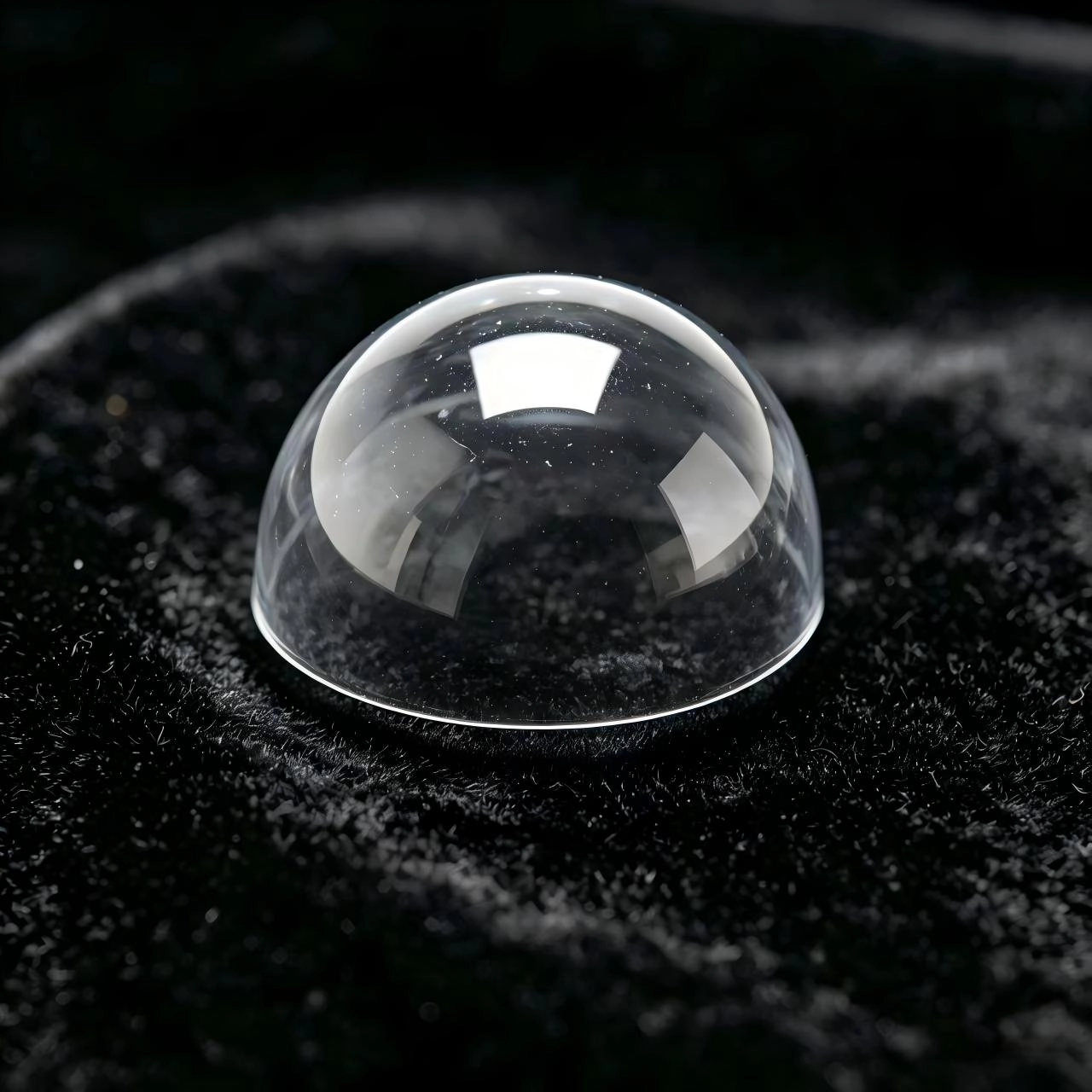
In the vast and demanding underwater world, where light is scarce, pressure is immense, and conditions are unpredictable, the performance of imaging and defense systems depends heavily on the materials used.
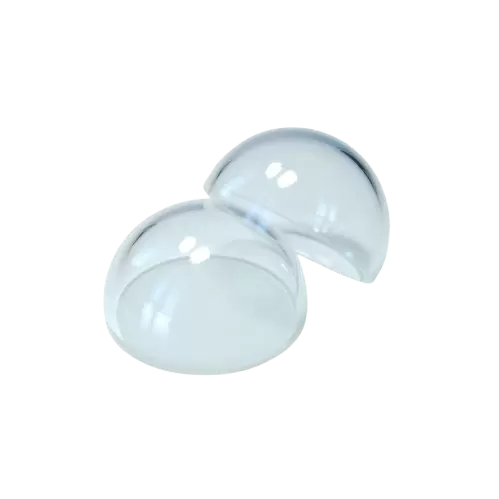
In modern large-scale architectural and industrial infrastructure projects, the evaluation of a super hemisphere dome is no longer driven by geometric appearance or architectural aesthetics.
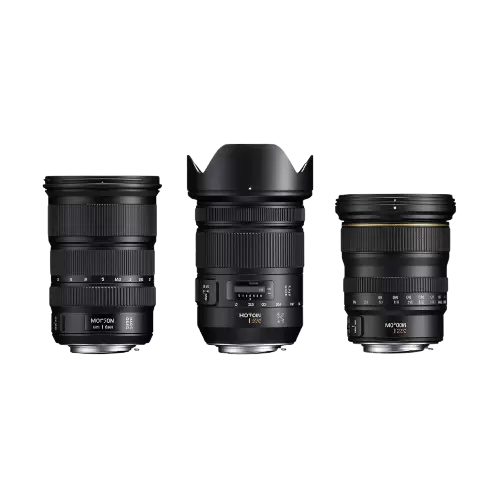
In industrial machine vision, lens selection directly affects whether a camera can produce images that are stable enough for measurement, inspection, and recognition. A consumer-grade lens or an unsuitable zoom lens may introduce changes in field of view, focus, magnification, or distortion when the focal setting changes.