

 en
en
 English
 繁体中文
繁体中文 Japanese
 Korean
 Russian
 German
News
Deepen Optoelectronic Resources, Lead Technological Breakthroughs

Deepen Optoelectronic Resources, Lead Technological Breakthroughs
When conventional spherical lenses are integrated into compact optoelectronic systems, the optical performance of the lens is only part of the engineering challenge. A complete spherical lens can be difficult to position, reference, and secure because its curved surface provides limited mechanical datum surfaces. In applications where optical alignment must be tightly controlled within a small package, this can increase mounting complexity and introduce alignment errors.
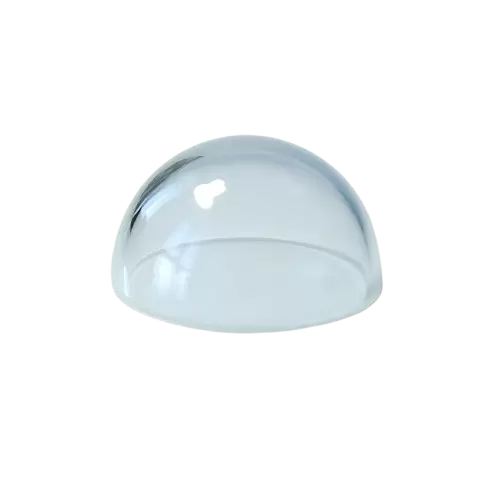
A Half Ball Lens addresses this mechanical limitation by combining the optical behavior of a spherical lens with a planar mounting surface. Typically produced by cutting a complete spherical lens along its equatorial plane, a Half Ball Lens forms a precise hemispherical geometry. The curved surface provides focusing characteristics, while the flat surface can be referenced directly against a substrate, holder, detector package, or optical assembly. For engineers comparing Half Ball Lens Price or evaluating Half Ball Lens for Sale, however, geometry alone is not enough. Radius accuracy, optical material, surface quality, dimensional tolerance, and coating specification all determine whether a particular lens is suitable for a precision optical system.
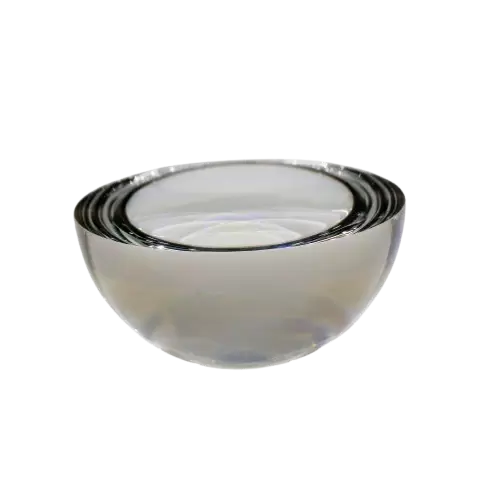
The most important optical parameter is the radius of curvature. For a hemispherical lens, the radius determines the curvature of the optical surface and therefore strongly influences the effective focal behavior of the component. A small deviation from the specified radius can shift the expected focal position, which becomes significant in fiber coupling, detector focusing, and compact imaging assemblies where the available working distance may be limited.
Diameter is equally important because it defines the usable optical aperture and also determines how the component interfaces with the mechanical structure. Center thickness must be controlled because it affects the actual geometry of the lens and the position of the optical surface relative to the planar reference. For a true hemisphere, the nominal center thickness is closely related to the radius, but the finished component still requires dimensional tolerances appropriate to the application.
Surface accuracy should be considered separately from surface quality. Surface accuracy describes how closely the polished surface conforms to the intended spherical figure, while surface quality commonly refers to scratch-dig specifications. A lens can have a good scratch-dig grade but still have insufficient surface figure for a demanding imaging or laser application.
For example, a 10-5 surface quality specification indicates a very fine scratch-dig level, helping reduce scattering from visible surface defects. It does not, by itself, guarantee that the spherical surface has the required radius or figure accuracy. Engineers should therefore review radius tolerance, surface figure, and surface quality as separate specifications.
The planar surface also requires attention. Flatness, parallelism, diameter tolerance, and edge geometry can directly influence how accurately the Half Ball Lens sits against its mounting reference. In a tightly aligned optoelectronic assembly, even a small mounting deviation can change the optical axis or introduce a tilt between the lens and detector.
Optical material should be selected according to wavelength, refractive index, dispersion, thermal environment, and manufacturing requirements rather than simply choosing the lowest Half Ball Lens Price.
K9 optical glass is a practical choice for many visible and near-infrared applications where cost, availability, and conventional optical processing are important. Its refractive index and dispersion characteristics make it suitable for general focusing and imaging applications, but it is not the first choice when broad UV transmission or demanding thermal stability is required.
Fused silica is better suited to systems requiring strong UV transmission, low absorption, good homogeneity, and excellent thermal stability. It is commonly considered for laser systems, UV imaging, and applications where thermal effects can influence optical alignment.
Sapphire provides high mechanical hardness, good transmission across important UV, visible, and near-infrared regions, and excellent environmental durability. It is particularly useful where the optical component must tolerate abrasion, contamination, or demanding operating conditions. Its high refractive index and birefringence, however, must be considered in optical design.
MgF2 has a low refractive index and broad transmission characteristics extending into the ultraviolet. It can be useful where UV performance and low-index behavior are important, although its material properties and manufacturing requirements need to be considered when designing a precision hemispherical component.
Silicon is fundamentally different from the visible-transmission materials above. It is widely used for infrared optical systems, particularly in wavelength ranges where silicon provides useful transmission. It is generally unsuitable when visible transmission is required because silicon absorbs strongly in the visible region. For IR imaging, sensing, and optoelectronic detection, however, it can be a highly relevant choice.
The correct selection therefore depends on the actual operating band. An optical designer should compare transmission, absorption, refractive index, dispersion, thermal behavior, and coating compatibility before comparing supplier prices.
Half Ball Lenses are useful when optical focusing and mechanical integration must be achieved within a compact assembly.
In fiber coupling systems, the curved surface can focus or collimate light while the planar surface simplifies positioning against a fiber holder or other reference structure. The required radius and diameter depend on the fiber type, numerical aperture, working distance, and coupling geometry.
Laser systems can use hemispherical optics for beam manipulation, focusing, sensing, or compact optical assemblies. In these applications, radius accuracy and surface figure become particularly important because wavefront errors can influence beam quality.
Imaging equipment can use Half Ball Lenses where space is restricted and the lens needs a defined mechanical reference. The optical designer must consider aberration, aperture, working distance, and the refractive index of the selected material rather than treating the component as a simple substitute for a conventional spherical lens.
They can also be used around photodetectors and precision optoelectronic instruments. Here, the mounting surface can simplify alignment between the optical axis and detector plane, while the curved surface provides the required optical power.
The main difference between a Half Ball Lens and a complete Spherical Lens is therefore not simply that one is smaller. A complete spherical lens has curved surfaces and generally requires a separate mechanical method for positioning and retaining the component. A Half Ball Lens provides one spherical optical surface together with a planar reference surface, which can make mechanical integration more straightforward in compact designs.
Coating selection becomes important when reflection losses are significant at the operating wavelength. An AR coating applied to the optical surface can reduce Fresnel reflection and increase transmission within the specified wavelength range.
The coating should be designed around the actual operating wavelength or wavelength band rather than selected as a generic specification. A visible-light system, a 1064 nm laser, and an infrared detector may require substantially different coating designs.
The coating process also becomes more demanding when the spherical surface has a small radius or when uniform coating performance must be maintained across the full aperture. For a precision Half Ball Lens, the coating specification should therefore include wavelength range, angle of incidence, target reflectance, environmental requirements, and the surface to be coated.
Half Ball Lens Price is determined by the complete specification rather than diameter alone.
Material is one of the first cost factors. Fused silica, sapphire, silicon, and specialized optical glasses can have substantially different raw-material and processing costs. Larger diameters increase material consumption and machining difficulty, while tighter radius-of-curvature tolerances require more precise grinding, polishing, and metrology.
Surface quality and surface figure also affect cost. A standard optical finish may be sufficient for a basic focusing application, while a demanding laser or imaging system may require tighter figure accuracy and a 10-5 scratch-dig specification. Dimensional tolerances on diameter, center thickness, and planar flatness add further manufacturing requirements.
Coating is another variable. A single-band AR coating for a defined laser wavelength is different from a broadband coating covering a wider spectral range. Inspection requirements can also influence the final price, particularly when customers require interferometric testing, dimensional reports, transmission measurements, or material certificates.
For buyers evaluating Half Ball Lens for Sale, the most useful comparison is therefore not simply the unit price. A lower-priced lens may have a looser radius tolerance, lower surface quality, wider dimensional tolerances, a different optical material, or a coating that does not match the actual operating wavelength.
ECOPTIK approaches these requirements from both the fabrication and engineering perspective. With 15 years of experience in optical component fabrication, ECOPTIK manufactures dome optics, spherical lenses, micro-optical components, cylindrical mirrors, filters, prisms, and windows. Available materials include optical glass from Schott, CDGM, and Corning, as well as sapphire, CaF2, MgF2, fused silica, silicon, ZnSe, and ZnS.
For customized Half Ball Lens projects, ECOPTIK can also provide lens assembly services. Its metrology capabilities include ZYGO laser interferometers for optical surface and wavefront evaluation, ZEISS CMM Spectrum for dimensional inspection, and an Agilent Cary 7000 UMS for optical measurements and product reporting.
For an optical system designer or procurement engineer, the right Half Ball Lens is ultimately the one whose geometry, material, surface specifications, coating, and dimensional tolerances match the system's actual optical and mechanical requirements. Comparing Half Ball Lens Price becomes meaningful only after these parameters have been defined. The same diameter can represent very different products when radius tolerance, material transmission, surface figure, 10-5 surface quality, coating performance, and inspection requirements are different. That specification-based approach provides a more reliable basis for selecting a Half Ball Lens for precision optics and optoelectronic systems.
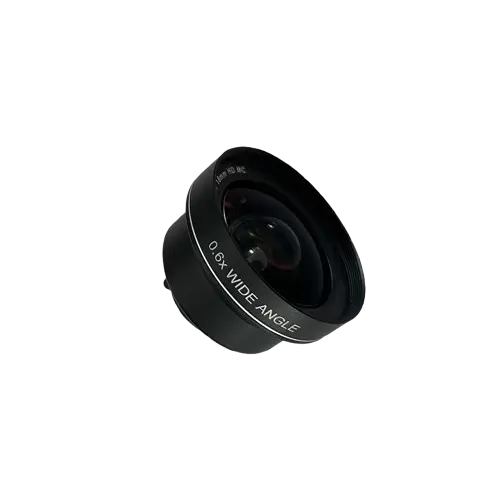
Conventional wide-angle lenses can capture more of a scene than standard lenses, but their field of view can still be insufficient when a vision system needs to cover a large area from a restricted installation position.
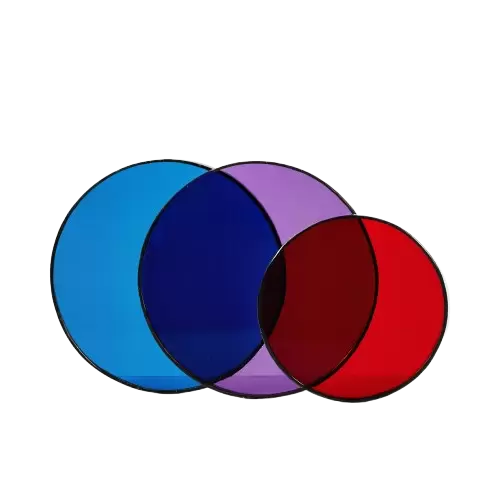
Selecting the right bandpass filter is not simply a matter of choosing a component that allows certain signals to pass. In optical systems, wireless communication equipment, and precision measurement devices, filter performance directly affects signal quality, detection accuracy, and system reliability.
Learn what a super hemisphere dome is in precision optics, how it protects sensitive systems, and why custom optical dome manufacturing matters.