

 en
en
 English
 繁体中文
繁体中文 Japanese
 Korean
 Russian
 German
News
Deepen Optoelectronic Resources, Lead Technological Breakthroughs


Deepen Optoelectronic Resources, Lead Technological Breakthroughs
In modern optical engineering, a plano concave lens is not simply a “diverging element,” but a controlled wavefront expansion component that defines how light is redistributed spatially before entering subsequent imaging or laser shaping stages. Especially in high-precision laser systems, machine vision architectures, and anamorphic beam shaping modules, Plano concave lens uses are tightly linked to divergence control accuracy, beam uniformity, and downstream optical stability rather than basic geometric optics behavior.
Unlike standard educational descriptions that treat negative lenses as simple beam expanders, real industrial applications require understanding how surface geometry, refractive index stability, and cylindrical symmetry influence one-dimensional beam modulation, particularly in systems using Plano Concave Cylindrical Lens configurations for line generation and aspect-ratio transformation.
At the same time, procurement and optical design engineers often face a recurring issue: lenses with identical focal length and material designation produce significantly different beam profiles once integrated into real optical systems. This discrepancy is not random—it originates from variations in surface form accuracy, micro-roughness control, and internal stress distribution within the glass substrate, all of which directly influence scattering behavior and wavefront distortion.
ECOPTIK, with 15 years of experience in precision optical component manufacturing, focuses on high-performance optical systems including cylindrical lenses, spherical lenses, prisms, filters, and windows. The company integrates advanced metrology systems such as ZYGO laser interferometers and ZEISS CMM platforms, enabling strict control of wavefront error, surface irregularity, and optical axis alignment. Material platforms include N-BK7, fused silica (UVFS), CaF₂, ZnSe, and other high-grade optical substrates used in industrial laser and imaging systems.
This manufacturing capability ensures that custom plano concave lenses maintain stable divergence behavior even under high-energy and high-frequency optical operation conditions.

In laser optical system design, one of the most critical Plano concave lens uses is controlled beam expansion prior to beam shaping or focusing stages, where a collimated laser beam must be deliberately diverged to adjust beam diameter, reduce energy density, or prepare spatial distribution for downstream optical elements.
However, in real engineering practice, beam expansion is not simply a geometric transformation—it is a wavefront engineering process where divergence angle, phase curvature, and intensity distribution must be precisely balanced to avoid downstream focal instability or energy non-uniformity.
When a plano concave lens is introduced into a laser expansion subsystem, the negative curvature of the lens surface induces controlled wavefront divergence, but the quality of this divergence depends heavily on surface smoothness and refractive index uniformity. If surface micro-roughness exceeds controlled thresholds (for example beyond 10–20 nm RMS), scattering increases significantly, leading to energy halo formation around the main beam profile, which directly reduces system efficiency in laser cutting or lithography applications.
In high-power laser environments, another critical constraint emerges: thermal lensing effect. Even minor absorption within the substrate can generate localized temperature gradients, causing refractive index variation that dynamically alters divergence angle. This results in unstable beam expansion ratios over time, which is unacceptable in precision industrial processing where consistent beam geometry is required.
When transitioning from spherical negative lenses to cylindrical configurations, Plano Concave Cylindrical Lens systems introduce directional control over beam divergence, enabling one-dimensional expansion while preserving orthogonal beam integrity.
In laser line generation systems, for example in semiconductor inspection or barcode scanning, the plano concave cylindrical lens is used to expand light along a single axis while maintaining collimation in the perpendicular axis. This creates a controlled line focus rather than a circular spot, which is essential for uniform illumination of slit-based detection arrays.
However, the engineering challenge is not simply achieving line formation—it is maintaining intensity uniformity along the generated line. Any deviation in cylindrical surface curvature introduces non-linear divergence across the beam profile, resulting in brightness variation, which directly impacts detection sensitivity in imaging sensors or industrial scanners.
In high-end systems, engineers often combine plano concave cylindrical lenses with plano convex cylindrical elements to achieve anamorphic beam correction, where beam aspect ratio is dynamically adjusted to match detector geometry or optical system constraints.
A frequently asked engineering question is why different custom plano concave lens products produce significantly different beam quality even when they share identical nominal specifications such as focal length, diameter, and glass type.
The primary reason lies in wavefront error accumulation, which is not visible at component level but becomes dominant when the lens is integrated into a multi-element optical system.
Surface figure deviation is one of the most critical factors. Even minor deviations in curvature symmetry introduce phase distortion across the transmitted wavefront, which leads to asymmetric beam divergence. This asymmetry becomes particularly problematic in high-resolution laser projection systems, where beam uniformity directly determines pattern fidelity.
Another critical factor is internal stress distribution within the glass substrate. During cooling and polishing processes, residual stress can remain trapped inside the material, causing refractive index gradients that subtly distort beam propagation. In high-precision optical systems, these gradients accumulate across multiple optical stages, eventually manifesting as beam drift or focus instability.
ECOPTIK addresses these issues through high-precision cold processing and nanometer-level polishing control techniques, ensuring that both surface geometry and subsurface stress distribution are optimized for stable optical performance in high-energy environments.
In advanced optical design, plano concave lenses are often used as part of anamorphic beam shaping systems, where circular laser beams must be transformed into elliptical or line-shaped profiles to match system constraints such as detector geometry, lithography exposure patterns, or industrial marking requirements.
In these systems, Plano concave lens uses are directly tied to spatial energy redistribution rather than simple divergence. The lens must not only expand the beam but also preserve phase coherence across the transformed wavefront to ensure predictable downstream focusing behavior.
If the optical axis alignment is not precisely controlled, even minor angular deviation can introduce astigmatism, leading to uneven focal distribution. This becomes especially critical in high-power laser systems where energy concentration must remain stable across repeated cycles.
In precision optical systems, surface accuracy is not an abstract specification—it directly determines wavefront integrity.
A plano concave lens with λ/4 surface accuracy at 632.8 nm wavelength ensures that phase distortion remains within controlled limits, allowing predictable beam propagation behavior across multiple optical elements.
However, when surface accuracy degrades to λ/2 or worse, cumulative wavefront distortion becomes significant enough to affect downstream focusing performance, particularly in long optical path systems where small errors accumulate over distance.
This is why high-end optical systems prioritize interferometric validation rather than geometric inspection alone, because only wavefront measurement can reveal actual optical behavior under operational conditions.
ECOPTIK has been deeply engaged in optical component fabrication for more than 15 years, specializing in precision optics used in industrial, scientific, and high-energy laser systems.
The company’s manufacturing system integrates:
High-precision cold processing and polishing for nanometer-level surface control
ZYGO laser interferometry for wavefront error measurement and optical surface validation
ZEISS CMM systems for dimensional accuracy verification
Multi-spectral transmission analysis using Agilent Cary 7000 UMS for optical performance validation across UV to infrared ranges
These capabilities ensure that every plano concave cylindrical lens maintains consistent optical behavior, particularly in terms of divergence control accuracy, surface uniformity, and thermal stability under continuous operation.
In high-power laser applications, Plano concave lens uses extend beyond beam shaping into energy density management, where controlled divergence is used to prevent premature optical damage to downstream components.
In precision measurement systems, plano concave lenses are used to adjust beam geometry before interference or scanning stages, ensuring that optical coherence is maintained across the measurement path.
In both cases, stability is more important than peak performance, because even slight variation in beam divergence can lead to measurement deviation or processing inconsistency.
Selecting a custom plano concave lens requires multi-parameter system-level evaluation rather than isolated specification matching.
Engineers must consider:
Divergence angle requirement based on downstream optical geometry
Surface figure accuracy relative to wavefront tolerance budget
Material selection based on wavelength range and thermal load
Cylindrical axis alignment precision in anamorphic systems
Coating uniformity for reflection control under high-power conditions
Incorrect selection can lead to beam instability, energy dispersion, or optical misalignment, all of which directly degrade system performance.
Understanding Plano concave lens uses requires a system-level optical engineering perspective, where divergence control, wavefront shaping, and beam uniformity are treated as integrated performance variables rather than isolated optical functions.
Similarly, Plano Concave Cylindrical Lens performance depends not only on geometric parameters but on surface precision, material homogeneity, and manufacturing stability under nanometer-scale control conditions.
ECOPTIK delivers high-precision custom plano concave lens solutions designed for demanding optical environments where beam stability, divergence control accuracy, and long-term operational reliability are critical.
For optical engineers and system designers, selecting a plano concave lens is ultimately a wavefront engineering decision that defines the performance ceiling of the entire optical system.
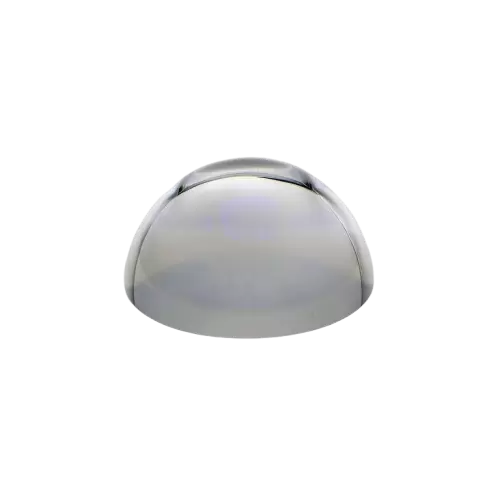
When conventional spherical lenses are integrated into compact optoelectronic systems, the optical performance of the lens is only part of the engineering challenge. A complete spherical lens can be difficult to position, reference, and secure because its curved surface provides limited mechanical datum surfaces.
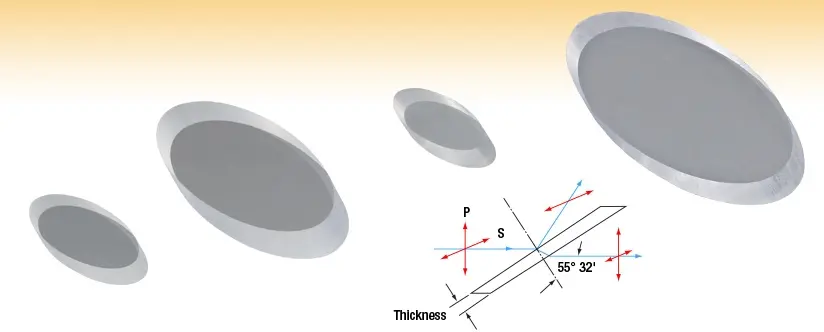
Brewster windows are critical uncoated optical components in high-power laser systems, enabling zero‑reflection-loss transmission for p‑polarized light at Brewster’s angle while suppressing s-polarized light.
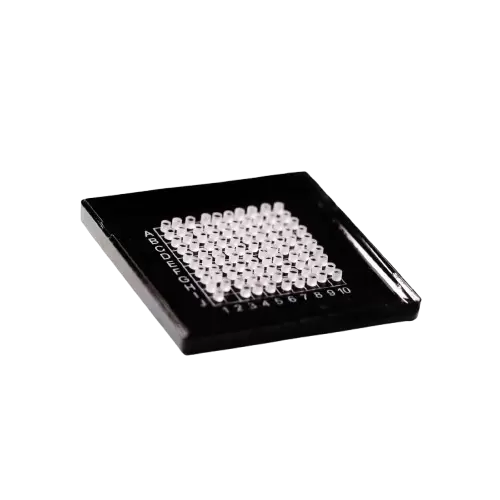
A compact optical system often has to solve a problem that a conventional spherical lens does not handle efficiently: controlling light in one direction while keeping the optical package small. In endoscopes, medical imaging modules, machine vision assemblies, and other precision instruments, a spherical lens may provide general imaging performance but cannot always deliver the required line-focusing behavior within a restricted optical path.