

 en
en
 English
 繁体中文
繁体中文 Japanese
 Korean
 Russian
 German
News
Deepen Optoelectronic Resources, Lead Technological Breakthroughs


Deepen Optoelectronic Resources, Lead Technological Breakthroughs
Selecting the right bandpass filter is not simply a matter of choosing a component that allows certain signals to pass. In optical systems, wireless communication equipment, and precision measurement devices, filter performance directly affects signal quality, detection accuracy, and system reliability.
Engineers often face several challenges when selecting a suitable filter. A filter with an unsuitable wavelength range or frequency response may fail to isolate the target signal. Lower-quality filters can introduce higher signal loss, insufficient rejection performance, or unstable spectral characteristics. At the same time, understanding the difference between filter types can be difficult, especially when comparing solutions such as low pass filters and bandpass filters.
Another important consideration is cost. The bandpass filter price is influenced by many technical factors, including center wavelength, bandwidth, optical materials, coating complexity, transmission requirements, and customization needs. A standard filter for general applications and a precision optical bandpass filter for scientific instruments may have significant differences in manufacturing difficulty and performance specifications.
For applications requiring accurate spectral selection, a high-performance bandpass filter provides a reliable solution by improving signal selectivity, reducing unwanted interference, and optimizing overall system performance.
ECOPTIK is an optical customization partner specializing in precision optical component fabrication. With 15 years of experience in optical manufacturing technology, ECOPTIK produces precision optics including dome lenses, spherical lenses, micro-optical components, cylindrical mirrors, filters, prisms, and windows. The company supports customized optical solutions using high-quality materials from suppliers such as Schott, CDGM, Corning, sapphire, CaF₂, MgF₂, fused silica, silicon, ZnSe, and ZnS. With advanced testing equipment including ZYGO laser interferometers, ZEISS CMM Spectrum, and Agilent Cary 7000 UMS, ECOPTIK provides reliable optical performance verification and product reports for demanding applications.
A bandpass filter is designed to transmit signals within a specific frequency or wavelength range while attenuating signals outside that range. Unlike general-purpose filters, a precision bandpass filter focuses on controlling a targeted spectral region with higher accuracy.
The performance of an optical bandpass filter is mainly determined by several key parameters.
The spectral curve shows how a filter responds across different wavelengths. It provides important information about:
Passband range
Transmission efficiency
Blocking performance
Cutoff characteristics
For optical detection systems, a well-controlled spectral curve ensures that only the required wavelength reaches the sensor while unwanted background light is suppressed.
For example, in fluorescence imaging applications, the target emission wavelength is often surrounded by unwanted excitation light and environmental interference. A precisely manufactured bandpass filter can separate the desired signal from background noise, improving image clarity and detection accuracy.
Bandwidth determines the range of frequencies or wavelengths allowed to pass through the filter.
A narrow bandwidth filter provides more precise selection capability, which is valuable in applications where signal separation is critical. However, achieving narrow bandwidth performance requires more precise optical coating technology and tighter manufacturing control.
In scientific instruments, optical inspection systems, and measurement equipment, narrow bandwidth filters help improve:
Signal identification accuracy
Measurement repeatability
Detection sensitivity
Transmission efficiency is another critical factor. A filter with high transmission allows more useful optical energy to reach the detector, reducing signal loss.
This is particularly important in systems where available signal levels are limited, such as:
Spectroscopy equipment
Imaging systems
Laser measurement devices
Optical communication systems
A well-designed bandpass filter balances high transmission within the target band and strong rejection outside the required range.
One of the common questions engineers search for is: What is the difference between low pass and bandpass filter?
The main difference lies in the frequency or wavelength range that each filter allows to pass.
A low pass filter allows signals below a specific cutoff frequency to pass while reducing higher-frequency signals. It is commonly used for applications such as noise reduction, signal smoothing, and power filtering.
A bandpass filter, on the other hand, allows only a selected range of frequencies or wavelengths to pass while blocking signals above and below that range.
The difference can be summarized as:
| Feature | Low Pass Filter | Bandpass Filter |
|---|---|---|
| Signal selection | Allows lower frequencies to pass | Allows a specific frequency range to pass |
| Main purpose | Remove high-frequency components | Select target signals and reject interference |
| Frequency control | Single cutoff point | Defined passband range |
| Typical applications | Signal processing, power filtering | RF communication, optical detection, imaging |
In wireless transmitters, bandpass filters help limit the output signal bandwidth to the allocated communication band. This prevents interference with other channels and improves spectrum utilization.
In wireless receivers, bandpass filters allow signals within the selected frequency range to be detected while blocking unwanted signals. This improves receiver sensitivity and optimizes the signal-to-noise ratio (SNR).
For optical systems, the same principle applies. A bandpass filter selects the required wavelength range and suppresses unwanted light sources, making it suitable for precision detection and imaging applications.
When customers compare different bandpass filter prices, the difference usually comes from performance requirements rather than the filter size alone.
Several factors directly influence manufacturing cost.
The required operating range is one of the most important factors.
A standard wavelength filter is generally easier to manufacture than a highly customized filter requiring precise spectral control.
Applications such as:
Laser systems
Fluorescence detection
Optical communication
Scientific instruments
often require customized wavelength specifications, increasing manufacturing complexity.
Bandwidth requirements strongly affect filter design and production difficulty.
A wider bandwidth filter may have simpler manufacturing requirements, while a narrow bandwidth filter requires:
More precise coating control
Advanced optical simulation
Strict quality inspection
The substrate material influences durability, transmission characteristics, and application compatibility.
Depending on the operating environment, manufacturers may select materials such as:
Fused silica for high-temperature applications
Sapphire for high durability
CaF₂ and MgF₂ for specific wavelength ranges
Optical glass for general precision applications
Material selection affects both performance and cost.
Optical coating is one of the most important manufacturing processes for bandpass filters.
High-quality coatings determine:
Transmission rate
Blocking level
Spectral stability
Environmental durability
ECOPTIK uses advanced optical fabrication processes and professional testing equipment to ensure that customized filters meet demanding performance requirements.
The best bandpass filter is not always the most expensive option. The correct choice depends on balancing optical performance, system requirements, and project budget.
Engineers should evaluate:
Required wavelength or frequency range
Bandwidth tolerance
Transmission requirements
Blocking performance
Environmental conditions
Customization needs
For applications requiring precise spectral control, working with an experienced optical manufacturer can reduce design risks and improve long-term system reliability.
With professional optical fabrication capabilities, advanced measurement equipment, and customized manufacturing support, ECOPTIK provides precision bandpass filter solutions for demanding applications. Whether used in optical inspection, imaging systems, scientific instruments, or wireless communication equipment, a properly designed bandpass filter helps improve signal quality, reduce interference, and achieve more reliable system performance.
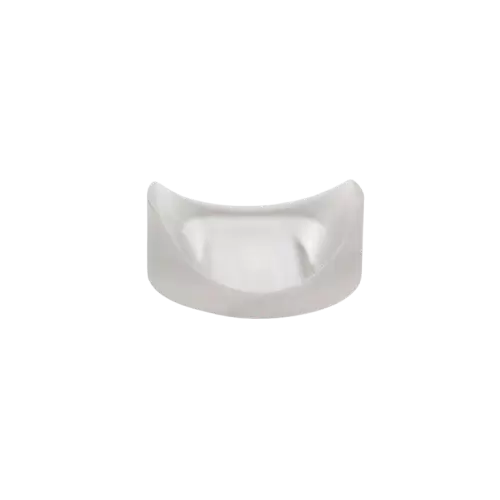
In many laser and imaging systems, controlling light in only one direction is a critical requirement. However, conventional cylindrical lenses can create challenges during integration, especially when optical alignment, positioning accuracy, and long-term stability are important.

In industrial laser metrology systems, laser line generation is not a visual aid but a geometric measurement reference that directly defines system-level accuracy boundaries.
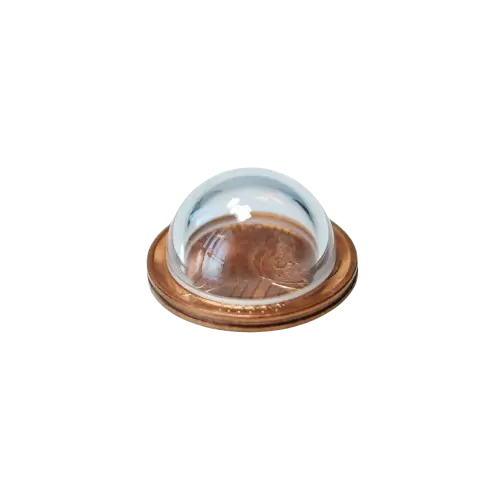
Compare super hemisphere dome and standard optical dome designs, performance, and applications to choose the right precision optical dome for your system.