

 en
en
 English
 繁体中文
繁体中文 Japanese
 Korean
 Russian
 German
News
Deepen Optoelectronic Resources, Lead Technological Breakthroughs


Deepen Optoelectronic Resources, Lead Technological Breakthroughs
Optical systems do not always need a lens that focuses light in two axes. When the objective is to generate a laser line, illuminate a linear detector, modify beam aspect ratio, or focus a collimated beam in only one direction, a spherical lens can introduce an unwanted optical effect. Its power acts on both axes, while many beam-shaping applications require control of only one.
This is where a plano-convex cylindrical lens becomes useful. Instead of treating it as a general-purpose focusing element, optical engineers should select it according to the required optical power, working distance, beam dimensions, wavelength, and surface specifications. For systems where line position and beam quality are critical, parameters such as focal length tolerance and surface accuracy can be just as important as the nominal lens diameter.
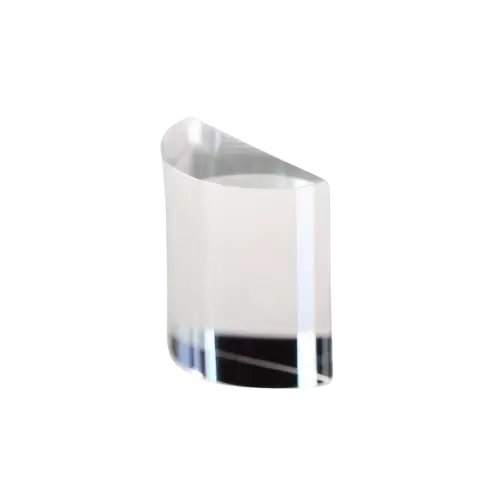
A plano-convex cylindrical lens has positive cylindrical optical power, meaning that it primarily changes the propagation of light along one axis while leaving the orthogonal axis substantially unaffected. This behavior makes it fundamentally different from a conventional spherical lens.
When a point source is positioned appropriately, the cylindrical lens can transform the point into a line image. With collimated input light, it can produce a line focus at the designed focal position. The same single-axis optical power can also compress or expand one dimension of an image, making the lens useful for changing beam aspect ratio.
This principle is particularly valuable in laser systems. In laser line generation, the focal length determines the relationship between the incoming beam and the line focus. A shorter focal length generally produces stronger convergence and allows a more compact optical arrangement, while a longer focal length provides a longer working distance and a different beam geometry.
For line detector illumination, the objective is often not simply to create the narrowest possible line. The focal position, line uniformity, beam diameter, and detector geometry all need to match. A lens with an unsuitable focal length may place the line outside the active detection plane even when the lens itself meets its nominal specification.
The same consideration applies to laser projection and anamorphic beam shaping. Because the optical power acts in one axis, a plano-convex cylindrical lens can modify the width-to-height ratio of an elliptical or asymmetric beam without applying equivalent focusing power to the other axis.
ECOPTIK manufactures precision optical components for applications requiring this type of controlled optical behavior. The company has researched optical component fabrication technology for 15 years and produces cylindrical mirrors, spherical lenses, dome optics, micro-optical components, filters, prisms, windows, and other precision optical elements. Its material capabilities include Schott and CDGM optical glass, Corning glass, sapphire, CaF₂, MgF₂, fused silica, silicon, ZnSe, and ZnS.
The specification sheet should be evaluated according to the optical system rather than as a collection of independent numbers.
Material is the first consideration because transmission depends strongly on wavelength. N-BK7/H-K9L is a common choice for visible and near-infrared optical systems, while fused silica is particularly useful when ultraviolet transmission or broader wavelength performance is required. CaF₂ can be considered for applications requiring suitable transmission characteristics across ultraviolet and infrared regions.
The available diameter range for ECOPTIK's plano-convex cylindrical lenses is 2 mm to 300 mm. The appropriate diameter depends on the incident beam size and the required clear aperture. A diameter that is unnecessarily large can increase package size and cost, while insufficient aperture can clip the beam and introduce unwanted diffraction or intensity variation.
Focal length is another primary selection parameter, with available values from 4 mm to 1000 mm. The correct focal length should be derived from the required working distance and beam geometry rather than selected simply because it provides a particular numerical specification.
For example, a compact laser focusing assembly may favor a short focal length, while a projection or inspection system with a longer working distance may require a substantially longer focal length. In anamorphic beam shaping, focal length must also be considered together with the incoming beam dimension and the desired change in aspect ratio.
Diameter tolerance is commonly specified at +0.0/-0.1 mm. Although this parameter may be less influential than focal length in many optical calculations, it becomes relevant when the cylindrical lens is mounted into a precision mechanical barrel or alignment structure.
A nominal focal length does not mean that every manufactured lens will place the optical focus at exactly the theoretical position. ECOPTIK can provide focal length tolerances ranging from ±1% for high-precision requirements to ±3% for less demanding applications.
The practical effect of this tolerance depends on the optical system. In a laser line focusing system, a focal length deviation changes the expected line-focus position. During assembly, this may require additional mechanical adjustment. In a system with limited adjustment travel, a larger focal length tolerance can become a design constraint rather than a simple manufacturing specification.
Surface quality and surface accuracy should also be treated as different parameters.
Surface quality, available as 40-20 or 60-40, relates to visible surface defects such as scratches and digs. These imperfections can contribute to scattering and stray light, which becomes more noticeable in laser applications where the optical system has a relatively high sensitivity to unwanted light.
Surface accuracy describes the deviation of the optical surface from its intended shape. ECOPTIK offers λ/2 and λ/4 specifications at 632.8 nm. A tighter surface accuracy can provide better control of the optical wavefront, which is particularly relevant when the cylindrical lens is used in precision focusing, laser projection, or imaging applications.
The appropriate specification is therefore determined by system sensitivity. A laboratory optical setup may require tighter surface accuracy than a general illumination system. Purchasing the highest available specification for every application, however, does not automatically provide a proportional system-level benefit.
The functional difference is more important than the difference in physical shape.
A plano-convex cylindrical lens provides positive cylindrical power and causes light to converge along one axis. It is therefore suited to applications such as line focusing, line generation, slit illumination, and one-axis beam compression.
A plano-concave cylindrical lens provides negative cylindrical power and causes light to diverge along one axis. Instead of creating a line focus, it can be used to expand one dimension of a beam or compensate for an existing beam geometry.
For this reason, the choice should begin with the required change in beam propagation:
Need one-axis convergence or line focusing → plano-convex cylindrical lens
Need one-axis divergence or beam expansion → plano-concave cylindrical lens
The incoming beam condition must then be considered. A collimated laser beam requiring a line focus calls for a different configuration from an already divergent beam that needs controlled expansion. Lens orientation, working distance, focal length, and beam diameter should therefore be evaluated together.
In an anamorphic system, for example, a plano-concave cylindrical lens may first expand one axis, while a positive cylindrical element can subsequently provide controlled convergence. The optical design determines whether one element or a combination is appropriate.
For laser line focusing, focal length and surface accuracy deserve particular attention because they influence where the line forms and how accurately the optical system controls the beam.
For line detector or slit illumination, the key considerations shift toward single-axis focusing, clear aperture, line uniformity, and the relationship between the focal plane and detector surface.
For laser projection, working distance, focal length, material transmission, and surface quality become more important because the optical system must maintain the intended line or image geometry over the projection path.
Anamorphic beam shaping requires another level of consideration. Engineers need to know the initial beam aspect ratio, which axis needs modification, the target aspect ratio, and the available optical path length. Selecting the cylindrical lens only by diameter or focal length without defining these requirements can result in an unsuitable beam profile.
ECOPTIK supports this type of application-oriented optical customization. Its manufacturing and inspection capabilities include ZYGO laser interferometers, ZEISS CMM Spectrum, and Agilent Cary 7000 UMS, allowing dimensional, surface, and spectral characteristics to be evaluated and reported according to project requirements. Lens assembly services are also available when the optical component needs to be integrated into a larger assembly rather than supplied as an individual element.
For optical engineers, the correct plano-convex cylindrical lens is determined by how its single-axis optical power interacts with the rest of the system. Diameter defines the available aperture, focal length establishes the focusing geometry, material determines wavelength suitability, and manufacturing tolerances influence how closely the physical component matches the optical design.
The available specification range of 2–300 mm diameter, 4–1000 mm focal length, ±1% to ±3% focal length tolerance, 40-20 or 60-40 surface quality, and λ/2 or λ/4 surface accuracy at 632.8 nm provides different options for laser, imaging, illumination, and beam-shaping requirements.
Rather than selecting a cylindrical lens based on size or nominal focal length alone, engineers should start with the beam diameter, wavelength, working distance, required line position, target beam aspect ratio, and system sensitivity to wavefront error and scattering. Understanding the functional difference between plano-convex and plano-concave cylindrical optics then makes it possible to choose the appropriate optical power and specification level for the application.
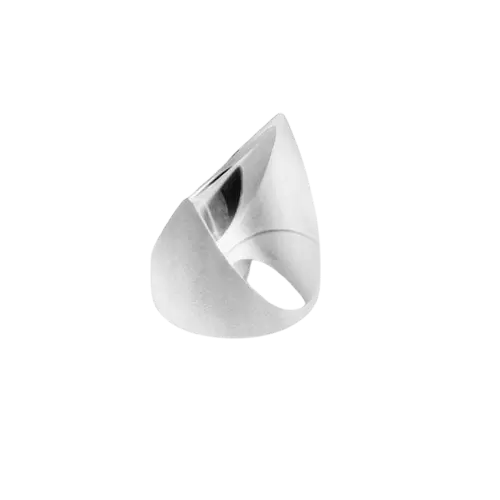
Laser systems used in industrial automation, precision measurement, semiconductor manufacturing, machine vision, and optical alignment increasingly require more than simply generating a laser beam.
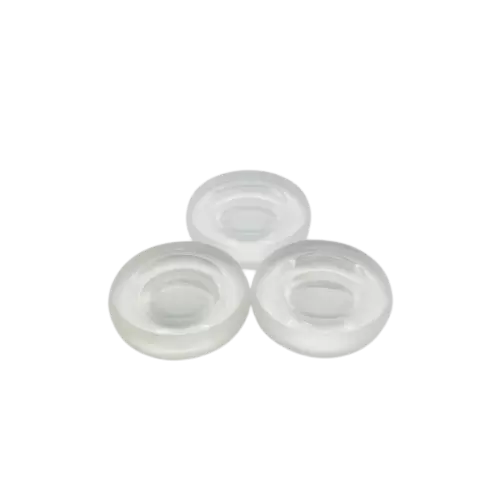
A positive lens is often the natural choice when an optical system needs to focus or converge light, but it cannot solve every beam-control problem. Laser and imaging systems may instead require a controlled increase in beam divergence, a larger beam diameter, or an adjustment that effectively increases the focal length of an existing optical arrangement.
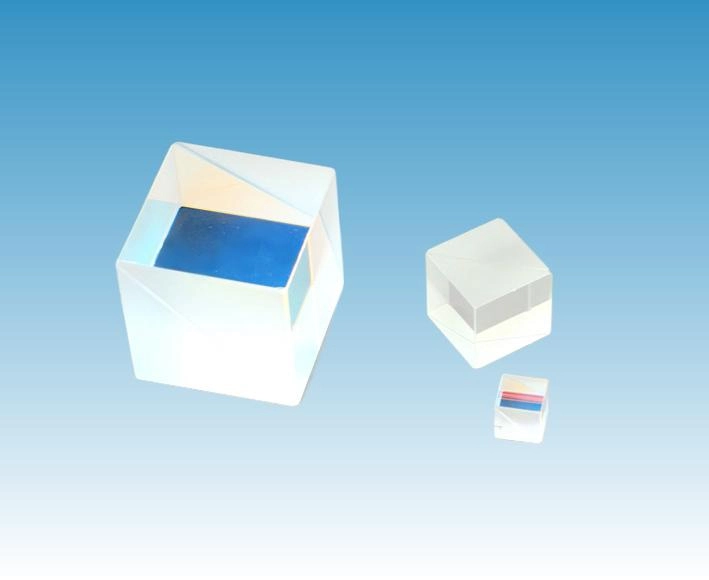
The cubic spectroscopic prism is an optical component with special geometric shape and optical properties, which is usually used for spectral analysis, refraction or changing the direction of light propagation.