

 en
en
 English
 繁体中文
繁体中文 Japanese
 Korean
 Russian
 German
News
Deepen Optoelectronic Resources, Lead Technological Breakthroughs


Deepen Optoelectronic Resources, Lead Technological Breakthroughs
In precision optical systems, controlling light in one direction is often only part of the design challenge. When different wavelengths pass through a conventional cylindrical lens, variations in refractive index can cause each wavelength to focus at a slightly different position. This chromatic effect becomes more noticeable in systems using broadband illumination, multiple laser wavelengths, or high-resolution imaging modules.
For traditional cylindrical lenses, the single-material design provides effective one-dimensional focusing and beam shaping, but it does not compensate for wavelength-dependent focal shifts. As a result, engineers may experience reduced image consistency, unstable beam profiles, and additional alignment requirements during system calibration.
This limitation has increased interest in Achromatic Cemented Cylindrical Lenses, which combine cylindrical beam control with chromatic aberration correction. By bonding two optical materials with different dispersion characteristics, these lenses are designed to maintain more stable optical behavior across multiple wavelengths while preserving the directional control required for laser and imaging applications.
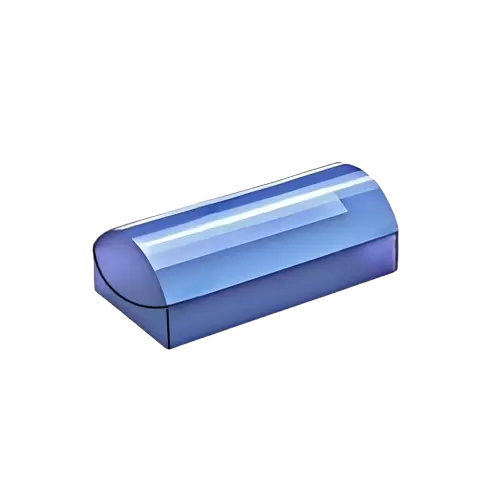
The fundamental difference between an achromatic cemented cylindrical lens and a conventional cylindrical lens is the optical structure.
A standard cylindrical lens normally uses one type of glass. Its curved surface changes the light path along a single axis, making it suitable for applications such as laser line generation, beam expansion, and beam compression. However, because optical glass has different refractive indexes at different wavelengths, the focal position can shift when the wavelength changes.
An achromatic cemented cylindrical lens solves this problem through a two-element bonded structure. Two glasses with different optical properties are carefully selected and combined to balance dispersion effects. Common material combinations include:
N-BK7 & N-SF5;
H-K9 & H-ZF13.
The higher dispersion difference between these materials allows the optical design to reduce wavelength-related focal variation. The result is more consistent beam shaping performance when the optical system operates with multiple wavelengths.
Unlike a spherical achromatic lens, which corrects two-dimensional focusing behavior, an achromatic cemented cylindrical lens maintains cylindrical optical power. It continues to modify light along only one axis, making it suitable for applications requiring directional beam control.
For example, in laser beam shaping systems, the lens can expand a narrow beam in one direction while maintaining the original beam characteristics in the perpendicular direction. In imaging systems, it helps reduce focus differences caused by wavelength changes, improving optical consistency when different illumination sources are used.
ECOPTIK provides customized optical solutions for these applications. As an optical customization partner, ECOPTIK has been researching optical component fabrication technology for 15 years and manufactures precision optics including dome, spherical lens, micro-optical components, cylindrical mirrors, filters, prisms, and windows.
The company supports various optical materials from Schott, CDGM, and Corning, as well as Sapphire, CaF₂, MgF₂, Fused Silica, Si, ZnSe, and ZnS. With lens assembly services and advanced testing equipment including ZYGO laser interferometers, ZEISS CMM Spectrum, and Agilent Cary 7000 UMS, ECOPTIK provides optical components with verified performance data for demanding applications.
When engineers compare Achromatic Cemented Cylindrical Lenses vs Doublet, the key difference is not simply the number of optical elements. The design purpose and optical correction method determine the actual performance.
A conventional cylindrical lens uses a single optical material and provides basic one-dimensional beam control. It is suitable for systems where wavelength variation is limited, such as single-wavelength laser applications.
A doublet cylindrical lens contains two optical elements and can improve certain optical characteristics compared with a single lens. However, a standard doublet design does not automatically provide achromatic correction. Without specific material matching and optical optimization, wavelength-dependent focal shifts may still occur.
Achromatic cemented cylindrical lenses are specifically designed around chromatic compensation. The two glass materials work together to reduce dispersion differences, allowing the lens to maintain more stable focusing behavior across multiple wavelengths.
This difference is especially important in:
multi-wavelength laser systems;
precision imaging equipment;
spectroscopy instruments;
scientific measurement systems.
In these applications, uncontrolled chromatic variation can affect beam alignment, image accuracy, and measurement repeatability.
The price of achromatic cemented cylindrical lenses depends on several engineering factors rather than only the physical size of the lens.
Glass material combination
The selected glass pair directly affects chromatic correction capability. Combinations such as N-BK7/N-SF5 and H-K9/H-ZF13 require careful material matching and manufacturing control to achieve stable optical performance.
Diameter and dimensional requirements
ECOPTIK supports diameter ranges from 0.5mm to 150mm. Larger diameters require tighter control during grinding, polishing, and cementing because even small deformation or bonding stress can affect optical performance.
Focal length tolerance
Standard focal length tolerance ranges from ±1% to ±3%, while precision grades can achieve ±1%.
For laser systems, focal length deviation directly influences beam expansion ratio, focusing position, and alignment accuracy.
Surface quality and accuracy
Surface quality options include:
60/40;
40/20;
10/5.
Higher surface quality reduces scattering and unwanted light loss in sensitive optical paths.
Surface accuracy options include:
λ/2;
λ/4;
λ/10 @632.8nm.
Improved surface accuracy helps maintain wavefront control in high-resolution imaging and precision measurement applications.
Center deviation and manufacturing control
Eccentricity is another important parameter. ECOPTIK provides center deviation options including:
<3 arc min;
<10 arc min.
Lower eccentricity helps maintain alignment between the cylindrical optical axis and mechanical mounting reference, reducing beam deviation in multi-element assemblies.
Coating selection is also customized according to wavelength range and application requirements. Anti-reflection coatings or other optical coatings can be applied depending on operating conditions.
The correct achromatic cemented cylindrical lens depends on the relationship between optical requirements and system design.
For laser beam shaping, the priority may be maintaining consistent beam dimensions across different wavelengths. For high-resolution imaging, controlling chromatic focal shifts may be more important. In scientific instruments, repeatability and optical stability often determine the final component selection.
ECOPTIK achromatic cemented cylindrical lenses support:
Glass combinations including N-BK7 & N-SF5 and H-K9 & H-ZF13;
Diameter range from 0.5mm to 150mm;
Diameter tolerance from +0.0/-0.1mm to ±0.025mm for high precision requirements;
Focal length tolerance from ±1% to ±3%;
Surface quality up to 10/5;
Surface accuracy up to λ/10 @632.8nm;
Center deviation below 3 arc min;
Customized coating solutions.
By combining chromatic correction, one-dimensional beam control, and precision manufacturing capability, achromatic cemented cylindrical lenses provide a practical solution for optical systems that require stable performance across multiple wavelengths. For laser processing, advanced imaging, and precision measurement equipment, the right cylindrical lens design can reduce optical adjustment challenges and improve long-term system consistency.
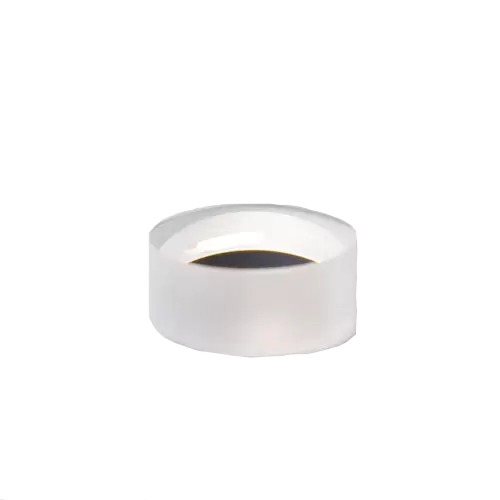
For optical engineers and procurement teams, choosing a plano concave lens is rarely just a matter of selecting a diameter. A lens may need to produce a specific negative focal length, control beam divergence, compensate spherical aberration, or work reliably at a particular wavelength.
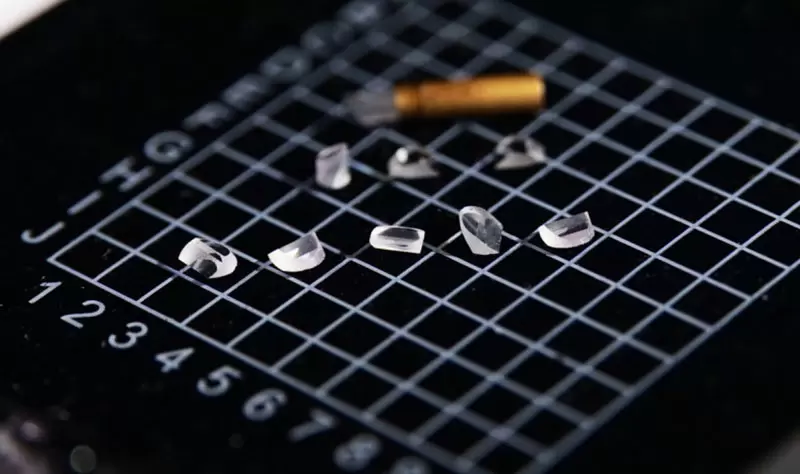
Endoscope is a medical tool used to examine organs and tissues inside the human body. It consists of a soft long tube with a small light source and camera at one end, which can transmit images to a display for doctors to observe.
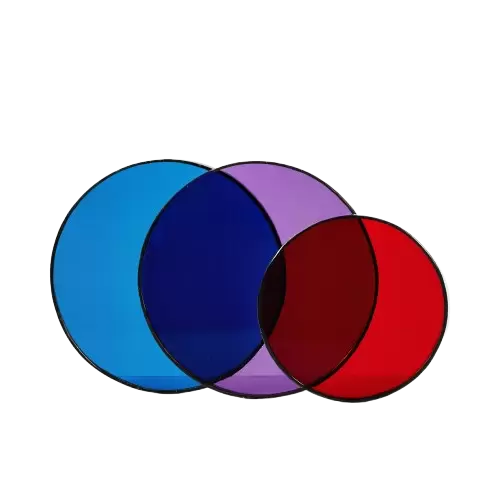
Selecting the right bandpass filter is not simply a matter of choosing a component that allows certain signals to pass. In optical systems, wireless communication equipment, and precision measurement devices, filter performance directly affects signal quality, detection accuracy, and system reliability.