

 en
en
 English
 繁体中文
繁体中文 Japanese
 Korean
 Russian
 German
News
Deepen Optoelectronic Resources, Lead Technological Breakthroughs


Deepen Optoelectronic Resources, Lead Technological Breakthroughs
In precision optical systems, mirror selection is often determined by factors that are invisible during normal operation but directly affect system accuracy. A mirror may appear perfectly reflective to the eye, yet its internal structure can introduce optical errors when used in laser alignment, imaging equipment, or scientific instruments.
Traditional rear surface mirrors place the reflective coating behind the glass substrate. Before reaching the reflective layer, incoming light must pass through the glass surface, creating additional reflections at the air-glass interface. This secondary reflection can produce ghost images, reduce image contrast, and introduce unwanted optical paths. In high-resolution imaging systems or laser applications, even small deviations caused by glass thickness, refractive index, or substrate stress may affect measurement accuracy and beam positioning.
For this reason, more optical engineers are turning to Front Surface Mirror Glass, which places the reflective coating directly on the first surface of the optical substrate. By reflecting light before it enters the glass, this structure minimizes optical distortion and provides cleaner, more accurate reflection performance for demanding applications.
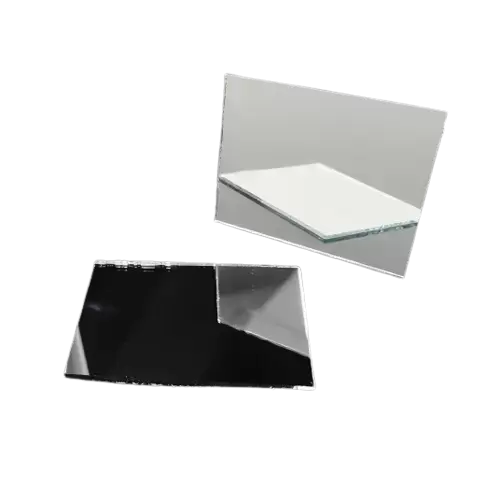
The key difference between a conventional mirror and a front surface mirror is the location of the reflective layer.
In a standard rear surface mirror, light travels through the transparent substrate before reaching the reflective coating. Because the light path changes when entering the glass, the reflected beam can be affected by refraction and secondary reflections. These effects become more noticeable when the optical system requires precise beam control, multiple reflections, or high-resolution image formation.
A Front Surface Mirror Glass eliminates this limitation by depositing the reflective coating directly onto the incident surface. The light interacts only with the coating layer instead of passing through the substrate first. This design prevents ghost reflections caused by the rear glass surface and maintains a more accurate optical path.
For laser systems, this advantage is especially important. Laser beams require precise angular control and stable reflection characteristics. Any unintended reflection or optical deviation can influence beam alignment, focusing accuracy, and energy distribution.
In imaging equipment and scientific instruments, eliminating ghost images helps improve contrast and preserve image details. This is critical for applications such as optical measurement systems, machine vision equipment, spectroscopy instruments, and research devices where signal accuracy depends on clean optical transmission and reflection.
ECOPTIK develops precision optical components based on these requirements. As an optical customization partner, ECOPTIK has researched optical component fabrication technology for 15 years and manufactures precision optics including dome windows, spherical lenses, micro-optical components, cylindrical mirrors, filters, prisms, and optical windows. The company provides customized optical solutions for applications requiring controlled reflection, accurate imaging, and long-term optical stability.
Selecting a Front Surface Mirror Sheet is not only about choosing a reflective surface. The substrate material, surface accuracy, coating type, and environmental protection layer all influence the final optical performance.
For optical substrates, ECOPTIK supports multiple material options according to application requirements.
K9 and BK7 optical glass are commonly selected for visible wavelength applications due to their stable optical properties, good processing performance, and compatibility with precision optical assemblies. These materials provide reliable performance for imaging systems, laboratory instruments, and general precision reflection applications.
For applications requiring ultraviolet performance, higher dimensional stability, or reduced thermal deformation, fused quartz and fused silica substrates provide significant advantages. Their low thermal expansion characteristics make them suitable for laser systems, high-precision measurement equipment, and environments where temperature variation could affect optical alignment.
Surface accuracy is another critical specification when selecting a precision mirror. The flatness of the mirror surface directly affects reflected wavefront quality.
ECOPTIK provides Front Surface Mirror Sheet with surface accuracy options including:
λ/10 for high-precision optical systems requiring strict wavefront control;
λ/4 for precision imaging and laser applications;
1λ (@633nm) for systems with less demanding optical tolerance requirements.
A more accurate surface minimizes wavefront distortion and helps optical engineers maintain predictable system performance.
The reflective coating selection should also match the operating wavelength and application environment. Different coating technologies provide different reflection characteristics.
Metal coatings offer flexible solutions for various spectral ranges:
Aluminum coating provides broad-spectrum reflection performance;
Protective aluminum coating adds environmental resistance against oxidation;
Reinforced aluminum coating improves reflectance performance in specific wavelength regions;
Silver coating provides strong reflection efficiency in visible and infrared applications;
Gold coating is commonly used for infrared optical systems due to its wavelength characteristics.
For applications requiring extremely high reflectivity at specific wavelengths, dielectric coatings provide a more specialized solution. Through multilayer thin-film design, dielectric high reflection coatings can achieve reflectivity above 99.9% at targeted wavelengths, making them suitable for advanced laser and scientific optical systems.
A front surface mirror operates in direct contact with incident light and environmental conditions, making coating protection an essential part of long-term reliability.
Metal reflective coatings, while offering excellent reflection performance, can be affected by oxidation or surface contamination without proper protection. To improve durability, ECOPTIK applies protective layers such as MgF₂ or SiO₂ over metal coatings.
These protective layers provide several practical advantages:
Reduce oxidation risk during long-term use;
Improve resistance against surface scratches;
Allow easier cleaning and maintenance;
Help maintain consistent optical performance in laboratory and industrial environments.
For optical systems operating under demanding conditions, thermal stability is equally important. Fused silica substrates combined with suitable coatings can reduce performance changes caused by temperature fluctuations, making them suitable for precision instruments, UV optical systems, and low thermal expansion applications.
ECOPTIK uses advanced inspection equipment, including ZYGO laser interferometers, ZEISS CMM Spectrum, and Agilent Cary 7000 UMS, to evaluate optical performance and provide product testing reports. These measurement capabilities support the verification of surface accuracy, dimensional performance, and coating characteristics for customized optical components.
The ideal Front Surface Mirror depends on the requirements of the optical system rather than a single performance parameter. A laser steering system may prioritize wavelength-specific dielectric coatings and λ/10 surface accuracy, while an imaging device may require excellent flatness, ghost-free reflection, and stable image quality.
When selecting a Front Surface Mirror Sheet, engineers should consider:
Whether the application requires visible, UV, or infrared wavelength performance;
The required surface accuracy and wavefront control level;
The substrate’s thermal expansion characteristics;
The expected environmental exposure;
The required reflectivity and coating durability.
Unlike conventional mirrors that may introduce secondary reflections through the glass substrate, Front Surface Mirror Glass provides direct reflection at the first optical surface, allowing more accurate beam control and clearer image formation.
With customized substrate options, precision manufacturing capability, advanced coating technologies, and professional optical testing, ECOPTIK provides Front Surface Mirror solutions designed for laser systems, imaging equipment, scientific instruments, and other precision optical applications where reflection accuracy and long-term stability are essential.
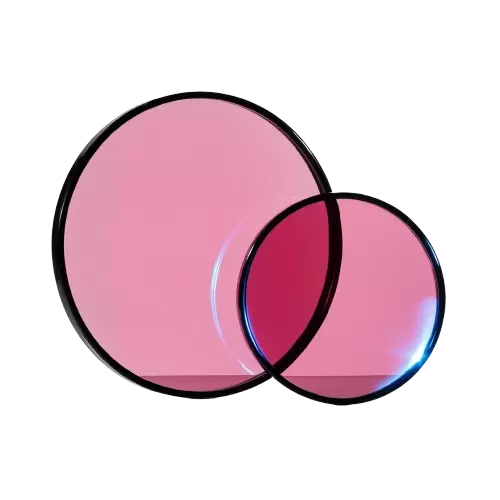
In precision optical systems, selecting the correct wavelength is often more important than simply collecting more light. Conventional optical filters may struggle with limited spectral selectivity, unstable center wavelength control, insufficient out-of-band blocking, and unwanted stray light interference.
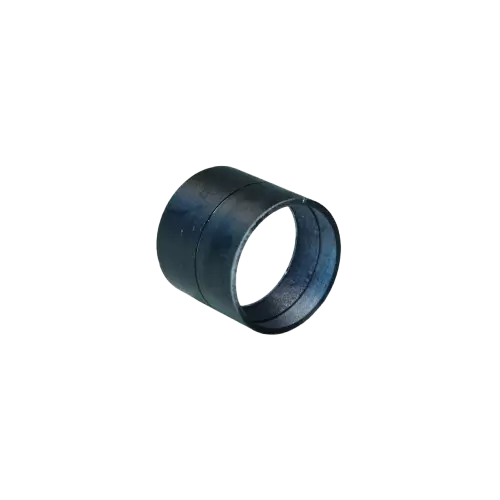
High-performance optical systems are no longer evaluated solely by focal length or magnification. As industrial inspection, machine vision, microscopy, spectroscopy, and scientific imaging continue to demand higher spatial resolution and greater measurement accuracy, optical designers are placing increasing emphasis on chromatic correction, wavefront quality, imaging consistency, and long-term optical stability.
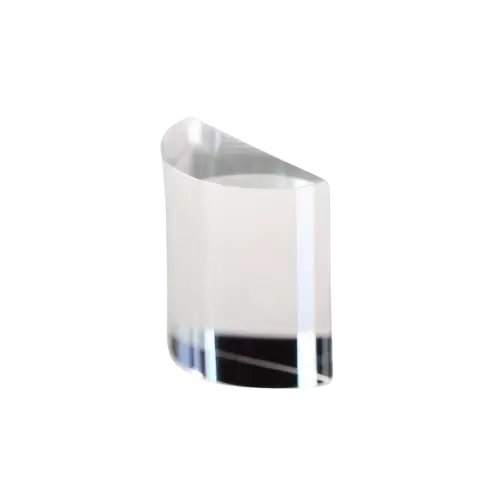
Optical systems do not always need a lens that focuses light in two axes. When the objective is to generate a laser line, illuminate a linear detector, modify beam aspect ratio, or focus a collimated beam in only one direction, a spherical lens can introduce an unwanted optical effect.