

 en
en
 English
 繁体中文
繁体中文 Japanese
 Korean
 Russian
 German
News
Deepen Optoelectronic Resources, Lead Technological Breakthroughs


Deepen Optoelectronic Resources, Lead Technological Breakthroughs
Standard optical prisms are not always practical when an optical path has to fit inside a few millimeters. In endoscopes, laser modules, fiber-coupling assemblies, and compact industrial instruments, a conventional prism can consume too much space, introduce unwanted optical path length, or simply lack the angular precision required by the system.
This is where micro prisms become useful. With dimensions from 0.2 mm to 5 mm, a properly specified micro prism can redirect or fold a beam without taking up valuable space. But miniaturization alone does not determine whether a component will work. Angle tolerance, surface quality, flatness, clear aperture, substrate material, and coating all affect the final optical result—and they also have a direct impact on Micro Prism Price.
For buyers comparing Micro Prism for Sale options, the right approach is to match each specification to the actual optical requirement rather than selecting the lowest unit price.
A micro prism may occupy only a fraction of the space of a conventional optical prism, but manufacturing becomes more demanding as the dimensions decrease.
ECOPTIK's micro prisms are available in dimensions from 0.2 mm to 5 mm. At this scale, relatively small manufacturing deviations can represent a significant proportion of the total component size. Maintaining the intended prism geometry requires controlled grinding and polishing, while inspection must verify both dimensional accuracy and optical performance.
Angular accuracy is particularly important. ECOPTIK can provide an angle tolerance up to ±10 arc sec. For a beam-folding application, this specification directly influences the direction of the exiting beam. An angular error that appears negligible at the component level can become meaningful after propagation through a longer optical path or when coupling light into a small fiber core.
Surface quality also matters. Specifications such as 20/10 or 10/5 surface quality control the size and number of surface imperfections. For imaging systems, lower surface defect levels can help reduce scattering and unwanted artifacts. For laser and fiber applications, surface quality can affect transmitted beam quality and optical losses.
The same principle applies to surface flatness. A specification of λ/10 indicates a tightly controlled optical surface, reducing wavefront distortion introduced by the prism. This can be particularly relevant in imaging systems where the prism is positioned close to the image-forming optics.
Another specification that is easy to overlook is clear aperture. ECOPTIK provides a clear aperture of more than 90% of the dimension. In a small prism, losing even a small portion of the usable aperture can become significant when the optical beam is already tightly confined.
The geometry should be selected according to what the prism needs to do in the optical path—not simply according to its physical size.
A micro right-angle prism is useful when the optical design requires a predictable 90-degree beam redirection within a compact package. It can be considered for folded optical paths in medical instruments, imaging modules, and compact industrial optical assemblies.
For an endoscopic system, for example, the prism may need to redirect light while fitting into a very restricted distal assembly. Here, dimensional control and angular tolerance become closely connected to the alignment of the complete optical train.
A micro wedge prism introduces a controlled angular deviation rather than simply folding the beam by 90 degrees. This makes it useful where a small change in beam direction is part of the optical design.
In laser or fiber-coupling assemblies, the required wedge angle should be determined from the optical layout and alignment budget. Buying a prism with unnecessarily tight tolerances can increase cost without providing a practical system-level benefit.
A micro dove prism can be considered when the optical design requires beam manipulation associated with image orientation or rotation. Its geometry is more specialized than a simple right-angle prism, so dimensional and angular consistency become especially important when integrating it into a compact imaging assembly.
For medical imaging equipment, the prism should therefore be evaluated together with the imaging path, field of view, working distance, and available installation space.
A micro penta prism is suited to applications where a stable beam deviation is required from the prism geometry. It can be useful in precision optical instruments where maintaining the intended beam path is more important than simply minimizing component size.
For industrial optical equipment, the specification should be selected according to the instrument's angular budget and mechanical alignment tolerances.
Material selection should start with wavelength, thermal environment, transmission requirements, and manufacturing constraints.
BK7 glass is a practical choice for many visible and near-infrared optical systems. It is widely used in precision optical components and can offer a good balance between optical properties, machinability, and cost.
Fused silica becomes attractive when the application requires characteristics such as excellent transmission over a broader spectral range, low thermal expansion, or improved thermal stability. However, material selection should be made against the actual operating wavelength and environmental conditions rather than assuming one substrate is universally better.
ECOPTIK can provide glass materials from Schott, CDGM, and Corning, as well as sapphire, CaF₂, MgF₂, fused silica, Si, ZnSe, and ZnS. This range allows the substrate to be matched more closely to the wavelength and operating conditions of the optical system.
There is no meaningful universal price for a micro prism because the manufacturing specification determines much of the cost.
The main variables include:
Dimension: A 0.2 mm component can require more demanding handling and inspection than a larger prism, particularly when tight dimensional and angular tolerances are specified.
Substrate: BK7 and fused silica have different material costs and processing characteristics.
Angle tolerance: A requirement of up to ±10 arc sec demands tighter angular control and more capable measurement processes than a general-purpose prism.
Surface quality: Moving from 20/10 to 10/5 increases the surface-finishing and inspection requirements.
Surface flatness: λ/10 requires tighter control of the optical surface and corresponding interferometric measurement.
Clear aperture: Maintaining >90% of the component dimension requires careful control of edge quality and usable optical area.
Coating: Coating requirements depend on wavelength, incidence angle, reflectance/transmittance targets, and environmental requirements. A customized coating specification can therefore change the final price.
Quantity and customization: Prototype quantities, small batches, and highly customized geometries generally have different economics from repeat production. For medical and industrial equipment manufacturers, it is often more useful to evaluate the total cost of qualification, inspection, and repeatability rather than comparing only the initial sample price.
When sourcing a micro prism, the purchase specification should begin with the optical function.
For endoscopic imaging, define the required beam deviation, available envelope, wavelength, clear aperture, surface quality, and allowable wavefront error. A compact 0.2–5 mm prism may solve the space problem, but only if its angular and surface specifications fit the imaging system.
For LD-to-fiber coupling, start with the laser wavelength, beam diameter, divergence, fiber type, numerical aperture, and coupling geometry. Angle tolerance is especially important because the prism can change the beam direction before it reaches the coupling optics.
For medical and industrial instruments, dimensional repeatability and batch consistency may be as important as the nominal optical specification. A component that performs well in a prototype but varies significantly between production lots can create alignment and yield problems during assembly.
How much does a micro prism cost?
The price depends on dimension, substrate, prism structure, angle tolerance, surface quality, flatness, coating, quantity, and inspection requirements. A specification-based quotation is more meaningful than a generic unit price.
How small can a micro prism be?
ECOPTIK's stated dimension range is 0.2–5 mm. The practical minimum depends on the prism geometry, material, tolerance, and manufacturing process.
What tolerance can a micro prism achieve?
ECOPTIK offers an angle tolerance of up to ±10 arc sec, subject to the specific design and manufacturing requirements.
Which material is better for micro optical prisms?
There is no universal answer. BK7 can be appropriate for many conventional optical systems, while fused silica may be preferable for specific wavelength and thermal requirements.
How do I choose a micro prism for endoscopic or fiber-coupling applications?
Define the optical path first, then determine prism geometry, wavelength, substrate, dimensional envelope, angular tolerance, surface quality, flatness, clear aperture, and coating requirements.
For micro optics, the specification is only useful if the manufacturer can consistently produce and verify it.
ECOPTIK has 15 years of experience in optical component fabrication technology and manufactures precision optics including micro-optical components, prisms, lenses, mirrors, filters, and windows. Its material portfolio covers optical glasses from Schott, CDGM, and Corning, together with sapphire, CaF₂, MgF₂, fused silica, Si, ZnSe, and ZnS.
For inspection and product reporting, ECOPTIK uses equipment including ZYGO laser interferometers, ZEISS CMM Spectrum, and Agilent Cary 7000 UMS. These measurement capabilities are relevant when buyers require documented dimensional, surface, and optical performance rather than relying only on visual inspection.
ECOPTIK also provides lens assembly services, which can be useful when a micro prism is part of a larger optical subassembly rather than a standalone component.
The practical takeaway for procurement teams is straightforward: Micro Prism Price should be evaluated against the specification and the manufacturing capability required to achieve it. For a 0.2–5 mm prism used in an endoscope, LD-to-fiber coupling module, or precision industrial instrument, a few dollars of component-price difference can be far less important than angular accuracy, usable aperture, surface condition, and production consistency. Selecting the prism around the system's actual optical tolerance budget is therefore the more reliable way to control both performance and long-term procurement cost.
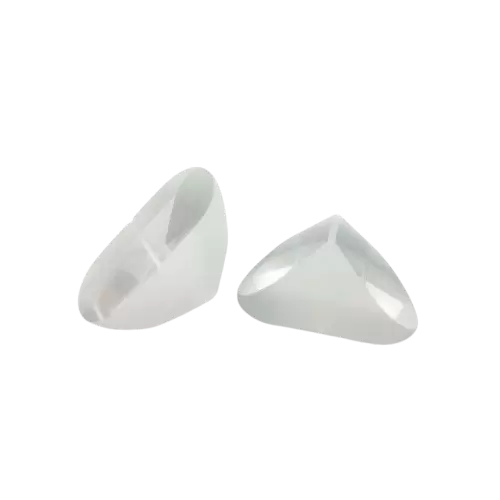
In precision optical measurement systems, the stability of the reflected light path directly affects the accuracy and reliability of measurement results. Traditional flat mirrors are widely used because of their simple structure and high reflection efficiency, but their performance depends heavily on precise installation and alignment.

A Micro Lens Array is a two-dimensional array composed of many tiny lenses. Each micro lens can focus the incident light onto a small area, and by controlling the focal length and position of each micro lens, control and adjustment of the light can be achieved.

Traditional prism systems have played an important role in binoculars, telescopes, and observation instruments for decades. Among them, Porro prism designs remain widely used because of their mature structure, reliable optical performance, and relatively simple manufacturing process.