

 en
en
 English
 繁体中文
繁体中文 Japanese
 Korean
 Russian
 German
News
Deepen Optoelectronic Resources, Lead Technological Breakthroughs


Deepen Optoelectronic Resources, Lead Technological Breakthroughs
In precision optical systems, selecting the correct wavelength is often more important than simply collecting more light. Conventional optical filters may struggle with limited spectral selectivity, unstable center wavelength control, insufficient out-of-band blocking, and unwanted stray light interference. These limitations can directly affect the accuracy of laser measurement systems, fluorescence analysis instruments, machine vision equipment, and scientific imaging platforms.
When optical signals are weak or surrounded by unwanted wavelengths, even small amounts of background radiation can reduce contrast and create measurement errors. A high-performance Narrow Bandpass Filter provides a practical solution by allowing only a specific wavelength range to pass while suppressing unwanted spectral components. Through accurate wavelength selection, high transmission efficiency, and strong optical blocking capability, narrowband filters help optical systems achieve cleaner signals and more reliable results.
ECOPTIK has been researching optical component fabrication technology for 15 years and provides customized optical solutions for demanding applications. As an optical manufacturing partner, ECOPTIK produces precision components including filters, lenses, prisms, windows, dome optics, spherical lenses, cylindrical mirrors, and micro-optical components. With advanced testing equipment such as ZYGO laser interferometers, ZEISS CMM Spectrum, and Agilent Cary 7000 UMS, ECOPTIK supports customers with reliable optical performance evaluation and product reports.

An Optical Bandpass Filter works by controlling the transmission of light through a carefully designed multilayer coating structure. Instead of allowing a broad spectrum of wavelengths to pass, a narrowband filter is engineered to transmit a selected wavelength range while blocking light outside the target band.
The working principle is based on dielectric interference. Multiple thin-film layers with different refractive indexes are deposited onto an optical substrate. Through controlled interference effects, these layers create a transmission window around the required wavelength while increasing attenuation outside the passband.
For advanced optical instruments, this wavelength control provides several advantages:
Improved signal-to-noise ratio by reducing unwanted spectral interference.
Lower background light levels for more accurate detection.
Better image contrast in optical imaging systems.
More reliable measurement results in spectroscopy and laser analysis.
ECOPTIK’s Narrow Bandpass Filter is manufactured using all-dielectric hard coating technology. This coating approach provides stable optical performance while maintaining spectral characteristics independently from the substrate material. As a result, the filter can be more easily integrated into different imaging systems and precision instruments without compromising optical performance.
One of the most important parameters when selecting a narrowband filter is FWHM (Full Width at Half Maximum), which defines the width of the transmission band.
Different applications require different bandwidth designs:
A 20nm FWHM filter provides stronger wavelength discrimination and is suitable for applications requiring accurate spectral separation, such as laser detection, fluorescence measurement, and analytical instruments.
A 30nm or 40nm FWHM filter offers a balance between wavelength selectivity and signal intensity. These bandwidth options are commonly used in imaging systems and optical inspection equipment where both signal strength and spectral control are important.
A 50nm or 60nm FWHM filter provides a wider transmission range while still reducing unnecessary wavelengths. This can be beneficial for machine vision applications and systems that need to capture more optical information without excessive background interference.
By offering customizable FWHM options, ECOPTIK allows engineers to select filter characteristics based on detector sensitivity, light source wavelength, and system design requirements.
Choosing a Narrow Bandpass Filter requires more than selecting a target wavelength. Optical engineers must consider several factors, including substrate material, surface quality, transmission performance, and blocking capability.
ECOPTIK provides narrowband filters with optical glass BK7 and Fused Silica substrates. BK7 is widely used in visible wavelength applications due to its excellent optical properties and cost efficiency, while Fused Silica provides superior thermal stability and transmission performance for demanding environments.
Surface quality is another important factor in precision optical applications. ECOPTIK supports surface quality specifications including 40/20 and 20/10, helping reduce scattering and maintain optical clarity in high-accuracy systems.
The available specifications include:
Material: Optical glass BK7 / Fused Silica
Surface Quality: 40/20, 20/10
Thickness: 0.5mm–5.0mm or customized requirements
Dimension Range: 3mm–200mm
FWHM: 20nm, 30nm, 40nm, 50nm, 60nm or customized
Wavelength Range: 340nm–1064nm
Optical Density: OD3, OD4, OD5
The wide wavelength range enables applications from ultraviolet detection at 340nm to near-infrared systems operating around 1064nm.
For users searching “What Does a Narrowband Filter Do”, the key function is extracting useful optical information from complex light environments.
In imaging systems, a narrowband filter isolates the wavelength associated with the target object or signal source. This reduces interference caused by ambient illumination and improves image contrast.
In laser detection systems, the filter blocks surrounding wavelengths and allows the detector to focus on the laser signal. This improves measurement stability and reduces false readings caused by environmental light.
In biomedical instruments, narrowband filters are widely used for fluorescence imaging and analysis. Fluorescent signals are often much weaker than surrounding light, making spectral filtering essential for accurate observation and measurement.
In scientific research equipment, narrowband filters support spectroscopy and optical analysis by providing controlled wavelength selection, enabling researchers to identify specific spectral characteristics more accurately.
The value of a professional optical filter is not only in blocking unwanted light. It is in controlling the optical environment so that detectors receive cleaner and more meaningful signals.
Different optical systems have different wavelength requirements, mechanical dimensions, and performance targets. A standard filter design may not always provide the best solution.
Professional optical filter suppliers need capabilities beyond manufacturing. Optical design experience, coating process control, material selection, and customization support are essential for developing reliable components.
With its optical fabrication expertise and customization capability, ECOPTIK supports customers requiring specific wavelength designs, bandwidth control, substrate selection, and dimensional adaptation. The company’s optical manufacturing experience covers various industries, including imaging, scientific research, industrial inspection, and medical instrumentation.
For precision optical systems, a well-designed Narrow Bandpass Filter can significantly improve detection reliability by controlling wavelength transmission, reducing background noise, and enhancing signal quality. Through advanced dielectric coating technology and customized optical solutions, ECOPTIK helps engineers integrate stable spectral control into next-generation optical instruments.
A Narrow Bandpass Filter plays a critical role in modern optical systems where wavelength accuracy and signal quality directly affect performance. By combining precise spectral selection, high transmission, strong optical density blocking, and stable coating technology, advanced optical filters help overcome common challenges such as background interference and inaccurate detection.
From laser measurement and fluorescence imaging to spectroscopy and industrial inspection, the right Optical Bandpass Filter provides the wavelength control required for reliable optical performance. With customizable specifications and advanced manufacturing capabilities, ECOPTIK delivers optical filter solutions designed for demanding precision applications.
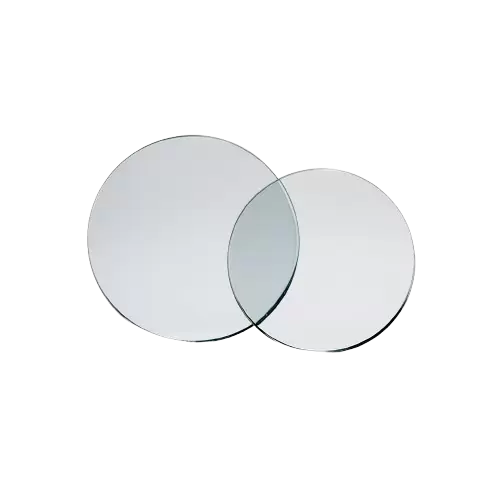
In modern photonic engineering, the concept of Precision optical window price cannot be understood purely as a unit cost of a transparent optical component.
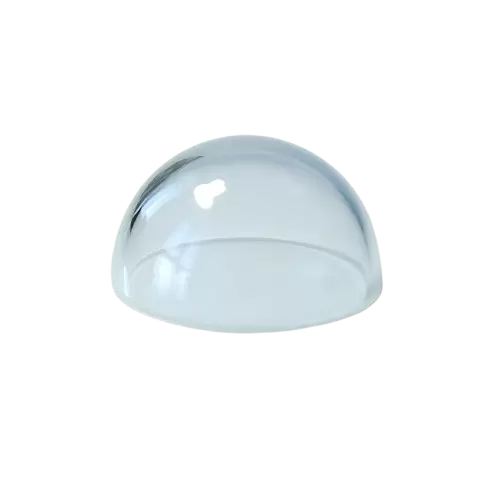
Learn what a super hemisphere dome is in precision optics, how it protects sensitive systems, and why custom optical dome manufacturing matters.

In modern optical engineering systems, especially in laser instrumentation, medical imaging, and industrial vision inspection, the role of a prism is no longer limited to simple beam deviation. For optical system designers and integrators working with precision optical prism lenses, the real challenge lies in maintaining sub-micron optical path stability, angular deviation accuracy, and multi-wavelength transmission consistency under complex system conditions.