

 en
en
 English
 繁体中文
繁体中文 Japanese
 Korean
 Russian
 German
News
Deepen Optoelectronic Resources, Lead Technological Breakthroughs


Deepen Optoelectronic Resources, Lead Technological Breakthroughs
For optical engineers and procurement teams, choosing a plano convex lens is rarely just a matter of selecting a diameter and focal length. A lens that appears simple can produce very different results depending on its material, curvature, surface accuracy, center deviation, coating, and installation direction. In focusing and imaging systems, insufficient control of spherical aberration or an unsuitable optical material can reduce spot quality, shift system performance, or increase alignment difficulty.
A plano convex lens has one flat surface and one convex surface, giving it a positive focal length. This asymmetric structure makes it one of the most practical positive lenses for focusing and controlling light paths. However, its performance depends on how the lens is specified and integrated into the optical system.
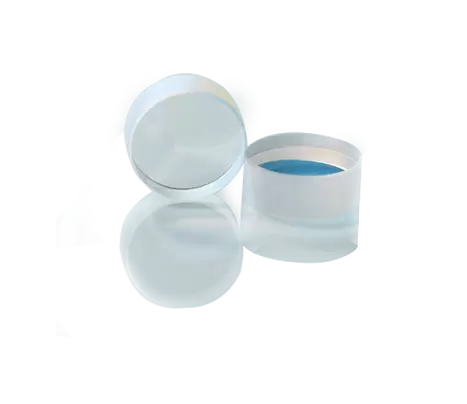
The defining characteristic of a plano convex lens is its positive focal length. When approximately parallel light enters the lens, refraction through the convex surface causes the rays to converge toward a focal point. This makes the lens useful when an optical system needs to concentrate light into a defined region rather than diverge it.
The relationship between object distance, image distance, and focal length is fundamental to system design. A short focal length generally provides stronger optical convergence, while a longer focal length produces weaker convergence and a longer working distance.
For procurement teams, however, focal length should not be considered independently. Diameter, curvature, material, and manufacturing tolerances all influence whether a lens will meet the intended optical performance.
The asymmetric design also matters for spherical aberration. A plano convex lens is not automatically free from aberration, but its curved and plane surfaces can be oriented to reduce spherical aberration under suitable optical conditions. When a collimated beam is focused, placing the curved surface toward the incoming collimated light is commonly preferred because it can reduce marginal-ray error compared with the reverse orientation.
This becomes particularly important in laser focusing and imaging systems where the focal spot, resolution, or energy distribution matters. The correct orientation is therefore part of optical design rather than simply an installation preference.
ECOPTIK manufactures plano convex lenses for applications where these specifications need to be controlled systematically. Available diameters range from 2 mm to 300 mm, covering compact optical modules as well as larger optical assemblies. Diameter tolerance can range from ±0.05 mm to ±1 mm, depending on the product and application requirements.
Surface quality is available from 80/50, 60/40 and 40/20 to 20/10 and 10/5, while surface accuracy can reach λ to λ/20. Center deviation options range from 3 arc min to 30 arc sec. These parameters are not simply quality labels: they determine how accurately the manufactured lens follows the intended optical geometry and how consistently it can be integrated into a precision system.
For example, tighter center deviation becomes more important when the lens is used in a beam path that is sensitive to angular misalignment. Higher surface accuracy can also be valuable in imaging or laser applications where wavefront quality is a significant design consideration.
The most common plano convex lens uses are based on its positive focal length and ability to redirect light toward a focus. Its actual role depends on the optical architecture.
Laser focusing is one of the most straightforward applications. A plano convex lens can concentrate a collimated laser beam onto a target plane, detector, workpiece, or sensing region. The required focal length depends on the desired working distance and beam geometry, while material and coating selection must match the laser wavelength and power level.
Beam collimation is another important application. A divergent beam from a point-like source can be converted toward a more parallel output when the lens is correctly selected and positioned. The lens curvature, focal length, source position, and wavelength all affect the resulting beam quality.
In imaging systems, plano convex lenses can serve as focusing elements where a relatively simple positive lens is appropriate. They may be used in optical instruments, machine vision modules, sensors, detectors, illumination assemblies, and other systems requiring controlled image formation.
They are also used for optical path control. Rather than treating the lens as an isolated component, engineers can use its positive optical power to establish a focal plane, relay light between components, or control the position of a beam waist.
There is no single installation direction that applies to every optical configuration. The correct orientation depends on the vergence of the incoming light and the intended function.
For a typical application in which a relatively collimated beam is being focused, the convex surface is generally placed toward the incoming beam to reduce spherical aberration. When the lens is being used in the reverse process to collimate light from a divergent source, the source-side orientation should be evaluated based on the source position and beam divergence.
For precision systems, engineers should therefore specify the optical configuration rather than simply asking for a generic “PCX lens.” Ray-tracing results, focal length, beam diameter, numerical aperture, working distance, and wavelength can all affect the final selection.
Plano convex lens price is influenced by considerably more than diameter.
Material is one of the first cost factors. ECOPTIK can provide optical-grade glass, fused silica, and sapphire according to application requirements. Optical glass may be appropriate for many visible and near-infrared systems, while fused silica can be advantageous when transmission range, thermal stability, or laser-related performance is important. Sapphire is selected for applications requiring high hardness and specific optical or environmental characteristics.
The material choice affects not only raw material cost but also grinding, polishing, coating, and inspection requirements.
Diameter and tolerance are another major factor. A 2 mm lens and a 300 mm lens require very different manufacturing processes, handling methods, tooling, and inspection procedures. Tight diameter tolerances also increase manufacturing control requirements.
Surface quality and surface accuracy have a direct relationship with manufacturing effort. Moving from a general 80/50 surface quality toward 20/10 or 10/5 requires more demanding polishing and inspection. Similarly, a surface accuracy requirement approaching λ/20 requires tighter control than a standard λ-level specification.
Center deviation also influences price. A requirement of 30 arc sec is substantially more demanding than a specification of several arc minutes because it requires more precise centering and inspection. This is particularly relevant to multi-element assemblies where angular or decentering errors can accumulate.
Coating requirements add another variable. The appropriate coating depends on wavelength, angle of incidence, substrate, power level, and transmission or reflection targets. ECOPTIK provides coatings according to customer requirements rather than treating coating as a one-size-fits-all option.
Consequently, comparing plano convex lens price based only on diameter can produce misleading purchasing decisions. Two lenses with the same diameter may have significantly different prices because their materials, focal lengths, tolerances, surface specifications, and coatings are different.
For engineering procurement, a reliable manufacturer should be evaluated by more than a catalog range or unit price. The supplier should be able to translate system requirements into manufacturable optical specifications and provide inspection data that supports acceptance.
ECOPTIK has 15 years of experience in optical component fabrication and manufactures precision optical components including dome optics, spherical lenses, micro-optical components, cylindrical mirrors, filters, prisms, and windows. Its material options include optical glass from Schott, CDGM, and Corning, as well as sapphire, CaF₂, MgF₂, fused silica, silicon, ZnSe, and ZnS.
For customers requiring more than individual lenses, ECOPTIK also provides lens assembly services, allowing component fabrication and assembly requirements to be considered together.
Inspection capability is another important purchasing consideration. ECOPTIK uses ZYGO laser interferometers, ZEISS CMM Spectrum, and Agilent Cary 7000 UMS for measurement and product reporting. These instruments support the verification of parameters such as surface accuracy, dimensional characteristics, and optical performance according to project requirements.
The practical answer to “How do I choose a reliable plano convex lens manufacturer?” is therefore to compare the manufacturer's ability to control the complete optical specification—not simply the quoted lens price.
Plano convex lens uses extend well beyond basic focusing. Its positive focal length makes it useful for laser focusing, beam collimation, imaging, optical instruments, and optical path control, while its asymmetric geometry provides an opportunity to manage spherical aberration when the lens is correctly designed and oriented. For procurement teams, the most meaningful comparison of plano convex lens price should include material, diameter, focal length, tolerances, surface quality, surface accuracy, center deviation, and coating requirements. Selecting these specifications according to the actual optical system can deliver a better balance between optical performance, manufacturing complexity, and total component cost.
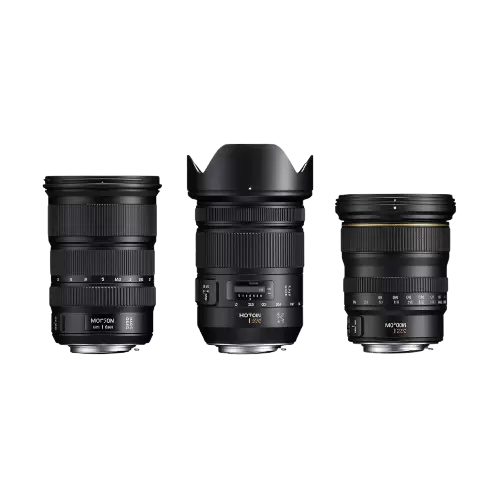
In industrial machine vision, lens selection directly affects whether a camera can produce images that are stable enough for measurement, inspection, and recognition. A consumer-grade lens or an unsuitable zoom lens may introduce changes in field of view, focus, magnification, or distortion when the focal setting changes.
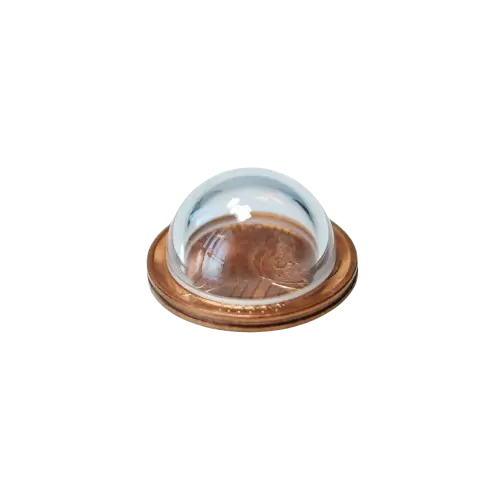
Compare super hemisphere dome and standard optical dome designs, performance, and applications to choose the right precision optical dome for your system.

In modern optical engineering, a plano concave lens is not simply a “diverging element,” but a controlled wavefront expansion component that defines how light is redistributed spatially before entering subsequent imaging or laser shaping stages.